How Much Should You Save Each Month in UAE 2026? A Salary-Based Plan

Written byZaib Azhar✓
September 4, 202614 min read
How much of your salary should you actually save in the UAE?
The popular answer is 20%. The 50/30/20 budgeting framework suggests roughly 50% of take-home income for needs, 30% for wants and 20% for savings and debt goals. But even the Consumer Financial Protection Bureau describes this type of split as a rule of thumb rather than something every household can follow.
That distinction matters in the UAE.
Someone earning AED 8,000 while sharing accommodation may be able to save a larger percentage than someone earning AED 12,000 who supports a family, pays rent and runs a car.
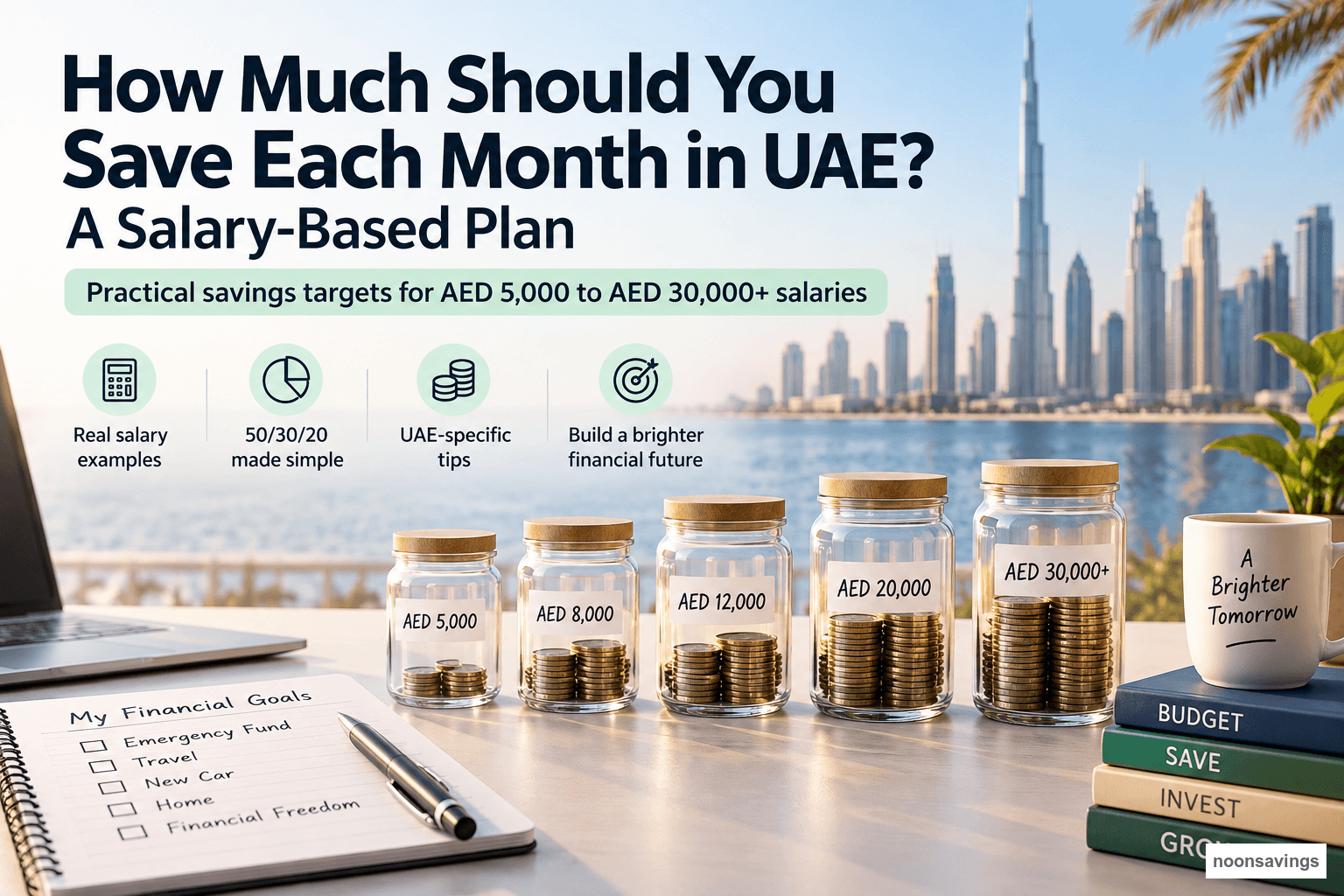
So instead of telling everyone to save exactly 20%, this guide uses AED 5,000, AED 8,000, AED 12,000, AED 20,000 and AED 30,000+ salaries to show what realistic starting points can look like.
Quick answer: Aim for 20% if your budget comfortably allows it, but don't force the number. Saving 5%–10% consistently is better than targeting 20% and relying on debt before the next payday.
The Consumer Financial Protection Bureau describes 50/30/20 as a budgeting rule of thumb, not a one-size-fits-all instruction. The UAE Ministry of Finance likewise presents the framework as something people can adapt to their needs and financial goals; see its official saving-awareness guidance.
Start With 50/30/20 — Then Adapt It

The standard framework looks like this:
| Category | Starting Point |
|---|---|
| Needs | 50% |
| Wants | 30% |
| Savings & debt goals | 20% |
Needs typically include housing, groceries, utilities and necessary transport, while wants include optional spending such as dining out and entertainment.
For an AED 12,000 monthly salary, the basic calculation would be:
- Needs: AED 6,000
- Wants: AED 3,600
- Savings/debt goals: AED 2,400
But don't distort your real budget just to make those percentages fit.
If rent, transport, groceries and family obligations consume 60% of your income, your current budget might realistically be closer to 60/25/15.
The goal is to improve your savings rate over time, not pretend your essential expenses are lower than they actually are.
What Should You Prioritise First?
Before saving for holidays, investments or a future home, build your financial foundation.
A practical order is:
- Bills buffer — build a small amount of accessible cash so an unexpected expense doesn't immediately go onto a credit card.
- Expensive debt — prioritise high-cost revolving debt while maintaining some emergency cash.
- Emergency fund — gradually work towards several months of essential expenses.
- Known future expenses — create separate pots for predictable costs such as car insurance, school expenses or annual travel.
- Long-term goals — once the basics are stronger, direct more towards larger savings and investment goals.
The UAE Ministry of Finance's financial-awareness material similarly recommends adding emergency savings to the monthly budget and describes three to six months of regular expenses as a useful emergency-fund target.
Use our Emergency Fund Calculator to estimate your target from your actual essential expenses rather than simply multiplying your salary.
How Much Should You Save on an AED 5,000 Salary?
At AED 5,000, a 20% target means:
AED 1,000 per month
That could be difficult if accommodation and transport already consume a large part of your income.
A more useful starting range might look like this:
| Illustrative Plan | Monthly Saving | Rate |
|---|---|---|
| Start small | AED 250 | 5% |
| Build momentum | AED 500 | 10% |
| 50/30/20 target | AED 1,000 | 20% |
These are illustrative planning examples, not UAE market averages.
If AED 250 is genuinely affordable, start there. That's still AED 3,000 over a year.
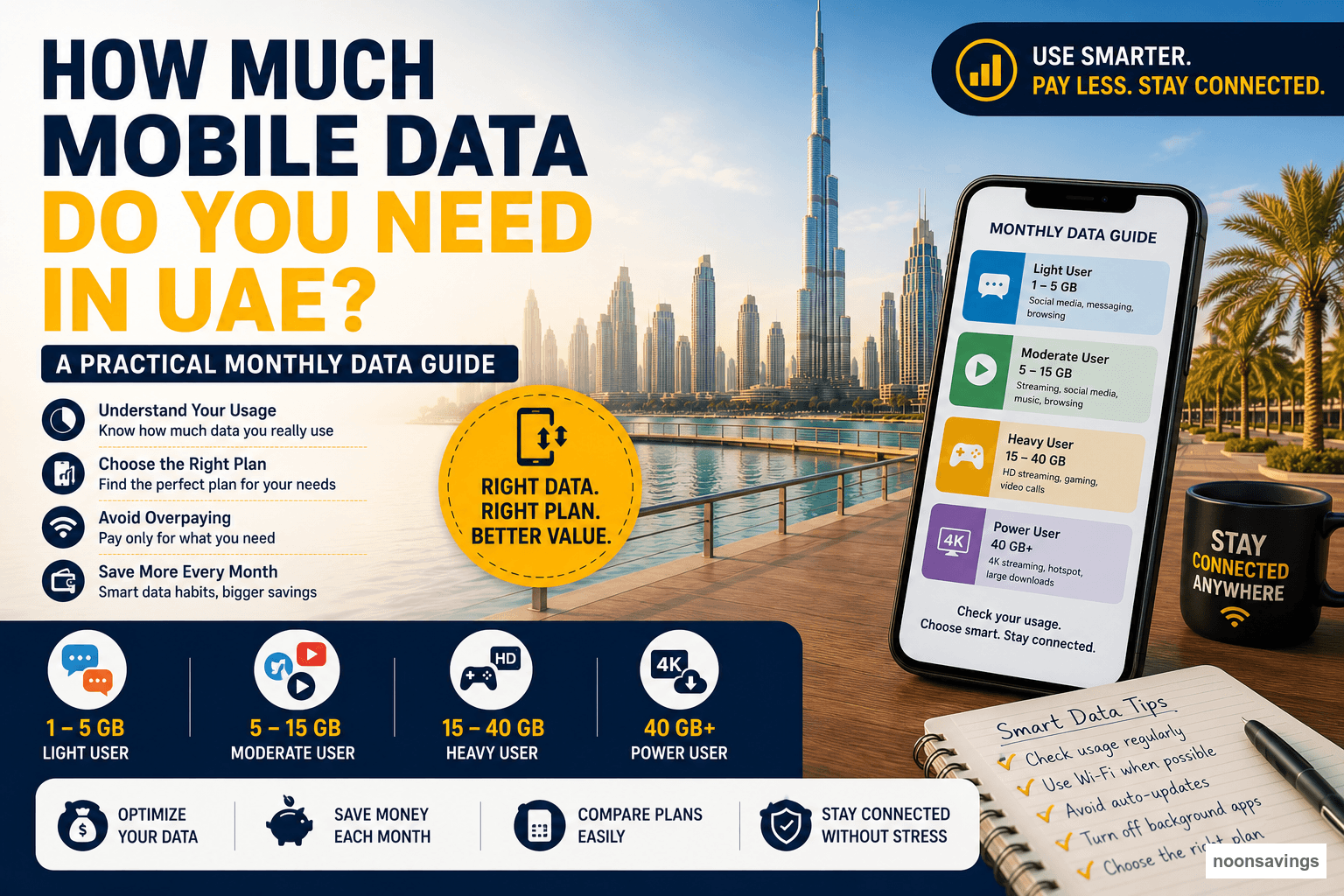
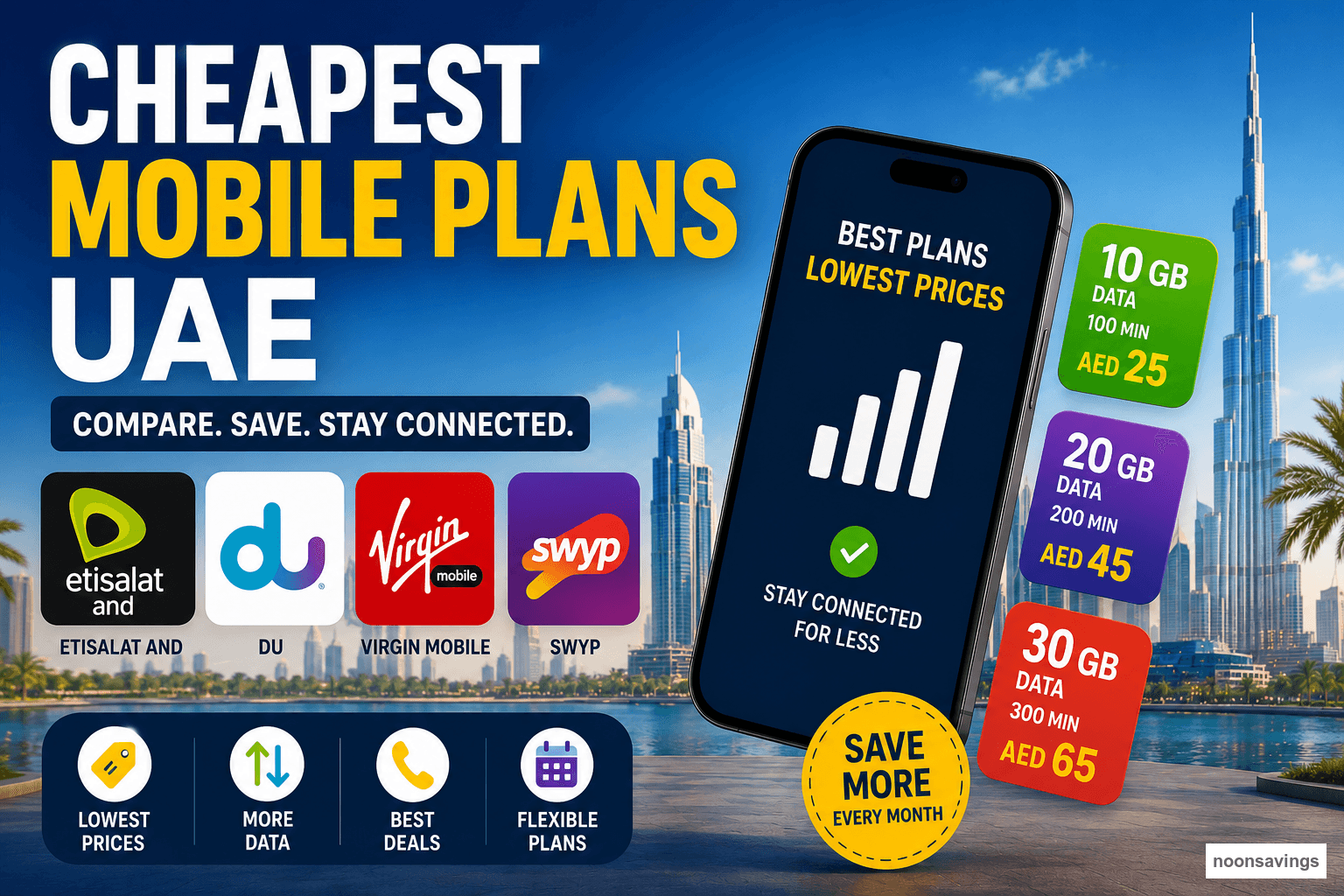
At this salary level, also look closely at recurring expenses. Comparing supermarkets and paying only for the mobile data you actually use can create extra room without requiring dramatic lifestyle changes.
See our budget supermarket comparison and UAE mobile data guide.
How Much Should You Save on an AED 8,000 Salary?
The same percentages give:
- 5%: AED 400
- 10%: AED 800
- 20%: AED 1,600
- 30%: AED 2,400
For example, someone paying relatively low rent and using public transport might comfortably reach AED 1,600.
Someone supporting family and paying higher housing costs may find AED 800 more sustainable.
Neither person's salary tells the whole story.
If you're unsure where your money is going, review two or three months of transactions and group them into:
housing → groceries → transport → family obligations → debt → bills → discretionary spending
That quickly shows whether the problem is lots of small purchases or one large fixed cost.
For a broader breakdown of the expenses you should account for, see our cost of living in Dubai guide.
Don't Chase a Savings Percentage You Can't Maintain
Suppose you decide to save 30% because it looks good on paper.
You transfer the money on payday, but two weeks later you need to use your credit card for groceries.
That's not a sustainable 30% savings rate.
Start with an amount you can leave untouched.
Then increase it when:
- your salary rises
- debt is cleared
- rent falls
- a recurring payment ends
- you reduce an unnecessary expense
Consistently saving 10% and gradually reaching 15% is more useful than repeatedly attempting 30% and withdrawing it again.
How Much Should You Save on an AED 12,000 Salary?
At AED 12,000 per month:
- 10%: AED 1,200
- 20%: AED 2,400
- 30%: AED 3,600
For many people, AED 1,200–AED 2,400 can be a useful range to test against their actual budget rather than treating AED 2,400 as compulsory.
Illustrative AED 12,000 Plan
| Category | Amount |
|---|---|
| Rent & utilities | AED 4,000 |
| Groceries | AED 1,400 |
| Transport | AED 1,200 |
| Family / other essentials | AED 1,400 |
| Wants | AED 1,600 |
| Savings | AED 2,400 |
| Total | AED 12,000 |
This is only an example—not an estimate of average UAE spending.
If your rent is AED 1,500 higher, for example, saving 20% may require cutting elsewhere. This is why your expense structure matters as much as your salary.
How Much Should You Save on an AED 20,000 Salary?
At AED 20,000:
- 10%: AED 2,000
- 20%: AED 4,000
- 30%: AED 6,000
If your essential costs are under control, this salary level may provide more room to move beyond the 20% starting point.
The bigger risk is lifestyle inflation.
A salary increase can quickly disappear into:
- a more expensive apartment
- a newer car
- more dining out
- additional subscriptions
- frequent travel and shopping
Suppose your salary rises from AED 16,000 to AED 20,000.
Instead of allowing the entire AED 4,000 increase to become new spending, you could direct half towards savings:
AED 2,000 → better lifestyle
AED 2,000 → additional savings
You still enjoy the raise while improving your financial position.
How Much Should You Save on an AED 30,000+ Salary?
At AED 30,000:
| Savings Rate | Monthly | Annual |
|---|---|---|
| 10% | AED 3,000 | AED 36,000 |
| 20% | AED 6,000 | AED 72,000 |
| 30% | AED 9,000 | AED 108,000 |
Higher income can make a 20%+ savings rate easier, but it doesn't guarantee it.
A family paying for larger accommodation, school fees, multiple cars and family support may have considerably higher essential costs.
The key question becomes:
How much of each salary increase is improving your long-term finances rather than permanently increasing your lifestyle costs?
If you comfortably save 30%, there is no reason to reduce it simply because 20% is a common budgeting benchmark. The UAE Ministry of Finance itself presents 50/30/20 as a formula that can be adjusted to suit your needs and goals.
Salary-Based Savings Plans Compared
Here's the simplest way to compare the five salary bands:
| Monthly Salary | 10% | 20% | 30% |
|---|---|---|---|
| AED 5,000 | AED 500 | AED 1,000 | AED 1,500 |
| AED 8,000 | AED 800 | AED 1,600 | AED 2,400 |
| AED 12,000 | AED 1,200 | AED 2,400 | AED 3,600 |
| AED 20,000 | AED 2,000 | AED 4,000 | AED 6,000 |
| AED 30,000 | AED 3,000 | AED 6,000 | AED 9,000 |
These numbers are illustrative calculations, not recommended UAE savings amounts.
A practical way to interpret them is:
- 5%–10%: useful starting point when your budget is tight
- 15%–20%: strong target if comfortably sustainable
- 30%+: excellent capacity if your expenses allow it
Don't judge your finances against someone else's percentage without knowing their housing, family and debt situation.
Rent, Transport and Family Costs Change the Answer
Two people earning AED 12,000 can have completely different savings capacity.
One might:
- share accommodation
- use the Metro
- have no dependants
Another might:
- rent a family apartment
- own a car
- support children
- regularly send money overseas
Comparing their savings amounts would tell you very little.
Look at Your Biggest Expenses First
If you want to increase savings, start with the categories that can actually move the needle:
Housing → transport → debt → groceries → recurring bills → discretionary spending
Saving AED 800 per month on a major recurring expense produces:
AED 9,600 per year
That's usually more meaningful than obsessing over every small purchase.
Our cost of living in Dubai guide can help you identify the major expenses that belong in your budget.
For variable spending, our budget supermarket comparison and UAE mobile data guide can help identify areas where you may be overpaying.
Separate Emergency Savings From Planned Spending
Not every dirham moved out of your current account is long-term savings.
Suppose you put aside:
AED 3,000 per month
but AED 1,000 is for an upcoming holiday and AED 500 is for annual car expenses.
Your breakdown is really:
| Purpose | Amount |
|---|---|
| Long-term/emergency savings | AED 1,500 |
| Holiday fund | AED 1,000 |
| Car sinking fund | AED 500 |
The holiday and car money are planned future spending.
Keeping these pots separate prevents you from thinking your emergency fund is larger than it really is.
The UAE Ministry of Finance recommends building an emergency reserve of roughly three to six months of regular expenses and keeping it accessible.
Use our Emergency Fund Calculator to calculate yours from actual essential expenses.
Automate a Realistic Amount on Payday
Once you know what you can genuinely afford, move that amount shortly after your salary arrives.
For example:
Salary: AED 12,000
Automatic savings: AED 1,500
Available for the rest of the month: AED 10,500
This follows the useful principle of saving before spending, which is also part of the UAE Ministry of Finance's budgeting guidance.
But don't automate AED 3,000 if you repeatedly need to transfer AED 1,500 back before payday.
Your real savings amount is AED 1,500.
A smaller amount that stays saved is better than a bigger number that only looks good on payday.
Turn Your Savings Percentage Into an Actual Goal
A percentage tells you how much to save each month.
A goal tells you why you're saving it.
Suppose you want AED 30,000 for a future goal within 18 months:
AED 30,000 ÷ 18 = about AED 1,667 per month
If AED 1,667 fits comfortably within your budget, you have a workable plan.
If you can currently save only AED 1,000, you can:
- extend the deadline
- reduce the target
- find another AED 667 of monthly saving capacity
The UAE Ministry of Finance similarly recommends dividing financial goals into short-, medium- and long-term objectives and giving them clear deadlines.
Use our Savings Goal Calculator to work backwards from your target and timeframe.
Where Should Your Monthly Savings Go?

You don't need to keep every dirham in one savings pot.
A simple order could be:
1. Bills Buffer
Build enough accessible cash to handle smaller unexpected expenses without immediately using debt.
2. Emergency Fund
Work towards several months of essential expenses.
The UAE Ministry of Finance suggests an emergency reserve of roughly three to six months of regular expenses, kept separately and somewhere accessible.
Our Emergency Fund Calculator can help estimate your target.
3. Predictable Future Costs
Set aside money for expenses you know are coming, such as:
- car insurance
- school-related costs
- annual travel
- visa expenses
- major purchases
These are better treated as sinking funds, not emergencies.
4. Longer-Term Goals
Once your immediate financial foundation is stronger, you can direct more of your monthly surplus towards longer-term savings or investments appropriate to your circumstances.
For cash you may need relatively soon, compare the options in our best savings accounts in UAE.
Save More Without Cutting Everything You Enjoy
You don't need to turn your life into an endless budgeting exercise.
Start with expenses that provide the least value.
For example:
Mobile plan: save AED 75 Unused subscriptions: save AED 100 Groceries: save AED 200 Delivery and other recurring costs: save AED 125
Total:
AED 500 per month
Annual saving:
AED 6,000
The important part is what happens next.
If you reduce spending by AED 500 but simply spend that AED 500 elsewhere, you haven't increased your savings.
Use a simple rule:
When you permanently reduce a recurring expense, automatically move the difference into savings.
Our budget supermarket comparison and UAE mobile data guide are useful places to look for recurring savings.
Save Part of Every Salary Increase
One of the easiest times to increase your savings rate is before you become accustomed to a higher salary.
Suppose your salary increases:
AED 12,000 → AED 14,000
Instead of adding the entire AED 2,000 to your monthly lifestyle, you could split it:
AED 1,000 → additional savings
AED 1,000 → additional spending capacity
Your lifestyle still improves, but your savings increase by:
AED 12,000 per year
There is no required 50/50 split. The principle is simply to prevent every salary increase from becoming permanent spending.
A Simple UAE Salary Savings Plan
If you want one framework to take away from this guide, use this:
| Salary | 10% | 20% | A Sensible Approach |
|---|---|---|---|
| AED 5,000 | AED 500 | AED 1,000 | Start small if essentials are tight |
| AED 8,000 | AED 800 | AED 1,600 | Build emergency savings steadily |
| AED 12,000 | AED 1,200 | AED 2,400 | Separate emergency and goal savings |
| AED 20,000 | AED 2,000 | AED 4,000 | Control lifestyle inflation |
| AED 30,000 | AED 3,000 | AED 6,000 | Consider pushing beyond 20% if comfortable |
These are illustrative calculations, not UAE market averages or fixed recommendations.
Your actual target should come from:
Income − essential costs − planned commitments − reasonable spending = realistic savings
Before Choosing Your Monthly Savings Target
Ask yourself:
- Do I know what I actually spend each month?
- Am I carrying expensive debt?
- Do I have a basic cash buffer?
- How much do I need for my emergency fund?
- Have I included annual expenses?
- Am I saving towards a specific goal?
- Can I maintain this amount without borrowing before payday?
If your savings regularly have to be withdrawn to cover normal expenses, reduce the target and fix the underlying budget first.
Frequently Asked Questions
How much of my salary should I save in UAE?
Around 20% can be a useful starting benchmark, but it is not a requirement. The UAE Ministry of Finance presents 50/30/20 as an adjustable budgeting formula rather than a ratio that must fit every household.
If 20% isn't realistic, start with 5% or 10% and increase it gradually.
How much should I save if I earn AED 5,000?
For illustration:
- 5% = AED 250
- 10% = AED 500
- 20% = AED 1,000
Choose the amount you can consistently leave saved after essential expenses.
How much should I save on an AED 10,000 salary?
Using the same framework:
- 10% = AED 1,000
- 20% = AED 2,000
- 30% = AED 3,000
Your realistic amount depends on rent, transport, debt and family obligations.
Is saving AED 1,000 per month good in UAE?
AED 1,000 per month becomes AED 12,000 over a year.
Whether that represents a strong savings rate depends on your income, but consistently saving AED 1,000 is meaningful progress if it fits your budget.
Should I save or pay off debt first?
Expensive debt deserves priority, but keeping some accessible emergency cash can help prevent the next unexpected expense from creating more debt.
Your appropriate balance depends on the type and cost of your debt and your financial circumstances.
How much emergency savings should I have?
A commonly used starting target is around three to six months of essential expenses rather than three to six months of your full salary. The UAE Ministry of Finance also uses a three-to-six-month expense range in its savings guidance.
Should I save at the beginning or end of the month?
Moving a realistic amount shortly after payday can make saving more consistent. The Ministry of Finance's budgeting guidance also recommends treating savings as a priority rather than simply waiting to see what remains at month-end.
Important Disclaimer
This guide is for general educational purposes and does not constitute financial, investment or debt advice.
All salary-based saving amounts shown are illustrative examples. They are not estimates of average UAE household savings or recommendations that everyone earning a particular salary should save the same amount.
Your appropriate savings rate depends on your income, expenses, debt, dependants, employment stability and financial goals.
Final Thoughts
You don't need a perfect savings percentage.
You need a percentage you can maintain.
If you're earning AED 5,000 and can genuinely save only 5%, start there.
If you're earning AED 12,000 and 20% comfortably fits your budget, that's AED 2,400 every month working towards your future.
And if you're earning AED 30,000+ with relatively controlled expenses, don't stop at 20% simply because a budgeting formula says so.
Start with 50/30/20, adapt it to your actual UAE living costs, and increase your savings rate as your circumstances improve. The Ministry of Finance explicitly notes that the formula can be adjusted to your needs and goals.
The best monthly savings target is not the highest number you can manage once.
It's the amount you can save consistently, keep saved and gradually increase over time.

Written byZaib Azhar✓
Zaib Azhar is a UAE-based web developer, photographer, and savings enthusiast who has been living in the UAE for over 12 years. Passionate about smart budgeting, cashback strategies, affordable living, and digital solutions, he shares practical insights to help residents save money and make informed financial decisions. With experience in web development, online research, and content creation, Zaib combines technology, creativity, and real-life UAE market knowledge to create useful guides on budgeting, banking offers, consumer deals, and cost-of-living tips.
View all articles by Zaib Azhar →