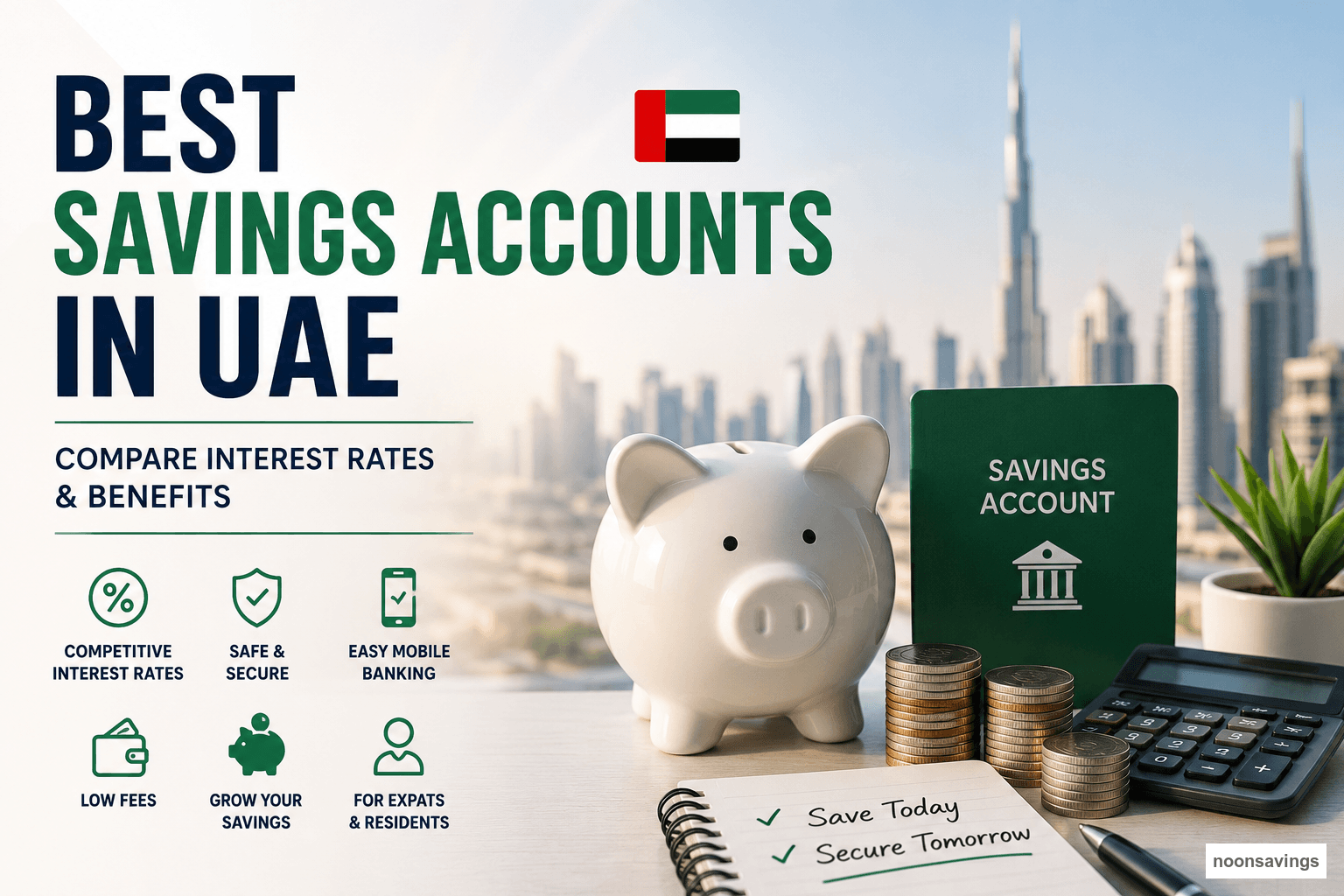
Best Savings Accounts in UAE (2026): Which Account Fits Your Goals?

Written byZaib Azhar✓
July 13, 202615 min read
The best savings account in the UAE is not always the one with the highest headline rate. In practice, the right account depends on what you are trying to do: park an emergency fund, build steady monthly savings, keep cash flexible, or squeeze the most out of a promotional return without locking money away for too long.
That distinction matters more than many comparison pages admit. A flashy rate can come with salary-transfer rules, monthly spend conditions, average-balance thresholds, or withdrawal limits. If those conditions do not match your real financial life, the “best” account on paper may not be the best account for you at all.
This guide is designed to help you choose a savings account in the UAE based on fit, not marketing. We will look at strong options for different saver profiles, explain the trade-offs clearly, and highlight when a simple or flexible account may be better than chasing the highest advertised rate. If you are still setting up your financial base, read our Emergency Fund UAE guide first and then review the best UAE banks for saving money alongside this page.
Important note on timing: several savings rates in the UAE are promotional or conditional. For example, some current offers referenced by banks are explicitly valid until August 31, 2026. Always verify the latest product terms, eligibility rules, and fee schedules directly with the bank before opening the account.
How to choose a savings account in the UAE
Before comparing brand names, answer one question first: what job should this money do?
- Emergency fund: your priority is access, safety, and low friction, not just the highest possible rate.
- Monthly salary savings: you may benefit from accounts that reward salary transfer or regular contribution behavior.
- Short-term goal savings: a higher-yield digital or goal-based product can be useful if the conditions suit you.
- Large idle balance: you need to pay close attention to balance caps, tiered rates, and whether the headline rate only applies to “new funds.”
- Sharia-compliant preference: product structure matters, not just the nominal return.
The biggest mistake people make is choosing a savings product like they choose a headline offer. The better approach is to match the account to the purpose of the money.
Quick comparison of strong UAE savings options
| Account | Best for | Why it stands out | Main watch-out |
|---|---|---|---|
| Mashreq NEO PLUS Saver | Rate-focused savers who can meet conditions | Very strong headline return for the right profile | Conditions matter: salary transfer or AED 50,000 average balance, plus limited debit activity |
| FAB iSave | People chasing a strong online promo with flexibility | No minimum balance and no withdrawal restriction | The top rate applies to new funds and has a published end date |
| Wio Saving Spaces / Salary Plan | Digital-first savers who like app-based planning | Strong digital experience and structured savings options | Best rates depend on plan type, fixed spaces, and sometimes salary transfer or spend behavior |
| ADCB Active Saver | People who want a mainstream bank with a saver-specific product | Clear online saver positioning with monthly interest crediting | Relationship or balance criteria can affect fees |
| Emirates NBD Plus Saver | Existing ENBD users who want an in-bank savings upgrade | Easy in-app opening and better positioning than a plain low-rate savings account | Still needs comparison against stronger digital alternatives |
| Liv Goal Account | People saving toward specific goals inside a digital app | Goal-based structure and automation mindset | Rate depends on plan type and, for top tiers, salary behavior |
Best savings account if you want the highest possible rate
If your priority is simply getting the strongest available return on cash while still staying in a savings-style product, the leaders in the UAE right now are usually not traditional plain savings accounts. They are conditional, digital-first products built around app usage, salary transfer, average balances, or saving “spaces.”
1. Mashreq NEO PLUS Saver: strongest for rate chasers who can meet the rules
Mashreq NEO PLUS Saver is one of the most eye-catching offers in the UAE market right now. As of August 4, 2026, Mashreq states a rate of 6.25% per annum if you transfer a salary of at least AED 10,000 into your Mashreq NEO account, or 5% per annum if you do not transfer salary but keep at least AED 50,000 as a monthly average balance in the NEO PLUS Saver account. The bank also states that interest is earned on balances up to AED 500,000.
That makes this product extremely relevant for savers who are serious about yield and can actually satisfy the conditions. It is especially attractive for salaried professionals who already want a digital-first setup and do not mind a more rule-based product.
But this is exactly where people need discipline. Mashreq also states that you can make only two debit transactions per month without impacting the interest payment for that month, and more than two debit transactions can lead to losing that month’s interest. So this is not the best account for an emergency fund you might dip into frequently. It is better for deliberate savings that you mostly leave alone.
Check the official Mashreq NEO PLUS Saver page for the live rate, salary-transfer rules, and debit-transaction condition.
2. Wio Salary Plan and Saving Spaces: strong if you like structure and app-led saving
Wio has become one of the most interesting names for savers who want a more modern, app-driven setup. Wio Personal currently states that users can earn up to 6% interest per annum with Family or Salary Plan structures, and the Salary Plan page specifically highlights 6% on one-month Fixed Saving Spaces with a minimum monthly spend condition, plus 3.25% on Saving Spaces without a minimum deposit.
Wio is useful because it frames saving as a system rather than a static account. For the right user, that can be better than a traditional bank account that simply holds cash. If you like creating separate buckets for goals, controlling money inside one interface, and building a digital habit around saving, Wio can be an excellent fit.
However, you should be precise about which Wio product you are comparing. A flexible saving space is not the same thing as a fixed saving space. A salary-based benefit is not the same thing as a standard account return. If you want simple “put cash in and forget it” banking, Wio may feel more product-led than you need. But if you want a digital savings workflow, it is one of the best options in the UAE market.
See the official Wio Personal site and Wio Save page for the current saving-space structure and plan benefits.
Best flexible savings account if you do not want restrictive rules
Not everyone wants to optimise every basis point of return. Many readers simply want a solid place to hold savings without too many traps, balance rules, or usage penalties.
3. FAB iSave: strong promo rate with very low friction
FAB iSave deserves attention because it combines a strong headline rate with a relatively simple account structure. FAB currently advertises 4.00% interest per year on new funds deposited in the iSave Account, with the published campaign running from May 1, 2023 to August 31, 2026. The bank also states that the account has no minimum balance requirement and no restrictions on the number of withdrawals.
That combination makes iSave one of the more practical offers for savers who want flexibility without a complicated activity rule. If you value access and do not want to count debit transactions or worry about balance penalties, this is easier to live with than some of the more conditional high-yield products.
The catch is the phrase new funds. That matters a lot. Promotional “new funds” logic can make an account look stronger than it may be for existing balances. It is still a very relevant option, but you need to confirm how the bank defines eligible funds at the moment you apply.
Review the official FAB iSave page for the latest promo window, no-minimum-balance rule, and withdrawal flexibility.
4. ADCB Active Saver: good for mainstream-bank confidence with saver intent
ADCB Active Saver is not the loudest offer in the market, but it is still one of the more relevant UAE savings products because it is clearly positioned for people who want an online saver account rather than a plain transactional balance. ADCB currently advertises up to 2.25% per annum on AED balances and says interest is calculated daily on the closing balance and paid monthly.
This can be a reasonable fit for savers who want a known mainstream bank, straightforward online access, and a product built around the savings use case. It is less exciting than the highest digital promo rates, but it may feel more stable and more familiar to some users.
That said, ADCB also notes that a monthly fee can apply if relationship balance criteria are not met. So this account is not automatically “simple” for everyone. It works best when you are already comfortable with ADCB’s relationship model or when the criteria are not a problem for you.
Check the official ADCB Active Saver page for the latest rate, monthly fee, and eligibility details.
Best savings account for an emergency fund
An emergency fund should not be forced into a product that punishes you for touching your own money. This is where many people make the wrong optimisation decision. They pick the account with the highest rate and then realise the structure is inconvenient for real-life emergencies.
For emergency savings, you should usually prioritise:
- fast access to funds
- low or no balance penalties
- no confusing usage restrictions
- low risk of losing interest because of normal account use
That means the best emergency-fund account is often not the most aggressive yield product. A flexible option such as FAB iSave can be more practical than a high-yield account with debit-transaction restrictions. For some readers, a simpler digital banking setup through the best digital banks in the UAE may also support better saving behavior than chasing a small extra return.
If you have not yet built your emergency reserve, stop here and read our Emergency Fund UAE guide. That article should shape the size and purpose of the savings account you open.
Best savings option if you already bank with Emirates NBD
Emirates NBD is a good example of why “best savings account” depends on context. If you already bank with ENBD, the best move may not be opening a completely new bank relationship. It may be upgrading from a low-yield standard savings structure to something more purposeful inside the same ecosystem.
5. Emirates NBD Plus Saver: more relevant than the plain standard savings account
Emirates NBD currently positions Plus Saver as an in-app savings option with rates of up to 3.5% p.a. and instant opening through ENBD X or Online Banking. That already makes it more interesting than the bank’s plain standard savings account, which is far less compelling from a yield perspective.
For comparison, ENBD’s standard savings account page shows a basic rate of 0.20% p.a. with a minimum balance requirement of AED 5,000. Its published KFS for current and savings accounts also shows that more basic or traditional savings variants can sit at very modest rates compared with newer, more targeted products.
See the official Emirates NBD Plus Saver page and the standard savings account page before deciding which ENBD option fits you.
So if you already use ENBD for day-to-day banking, the right question is not “Should I use ENBD at all?” It is “Which ENBD savings product makes sense for me?” Plus Saver is usually the more relevant place to start than the basic legacy-style option.
Best goal-based savings account for digital savers
Some people do not need the absolute highest rate. They need a system that helps them save consistently toward travel, home setup, education, or planned big expenses.
6. Liv Goal Account: useful when habit-building matters more than absolute yield
Liv’s Goal Account is interesting because it is built around the saving process, not just the balance. Liv highlights features like multiple goals, automated saving rules, and app-led goal tracking, which can be genuinely useful for people who save better when they can visually organise their money.
Liv also states that Goal Account rates vary by plan. Its published interest-rate page currently shows that some Goal Account tiers changed from March 1, 2026, and the stronger rates apply to Max users and especially those who transfer salary. That is an important reminder that you should not assume the headline marketing copy applies equally to every user tier.
This makes Liv more of a behavioral fit product than a universal “highest return” answer. If you want a digital savings habit and clean in-app goal management, it is relevant. If you are purely rate-maximising, another option may beat it.
Check the official Liv Goal Account page and Liv interest-rate page for the current tier structure.
Costs and conditions that matter more than the headline rate
This is the part too many comparison articles ignore. In the UAE savings market, the real value of an account often depends less on the top-line rate and more on the fine print underneath it.
- Salary transfer rules: some top rates only apply if your salary lands in the bank.
- Average balance thresholds: missing the required balance can reduce your rate sharply.
- Balance caps: the best rate may only apply up to a specific limit, such as AED 500,000.
- “New funds” wording: some promo rates do not apply to money you already held with the bank.
- Withdrawal limits: a high-yield product may stop paying interest if you use it too actively.
- Fees: some accounts can trigger monthly charges if relationship criteria are not met.
- End dates: a promotional rate is not the same thing as a permanent savings structure.
That is why the most honest way to compare UAE savings accounts is not to ask “Who has the highest rate?” but “Which account still works well after I factor in the conditions?”
Which savings account suits which type of saver?
If you want the shortest practical answer, use this framework:
- You want the highest possible rate and can follow conditions: start with Mashreq NEO PLUS Saver and compare it with Wio’s structured savings options.
- You want strong yield with easier day-to-day flexibility: FAB iSave is one of the best places to look first.
- You already bank with ENBD and want to improve your setup: compare Plus Saver against the bank’s more basic savings products.
- You want a mainstream bank saver account with monthly interest crediting: ADCB Active Saver is a reasonable candidate.
- You save better when goals are visual and automated: Liv Goal Account is worth considering.
- You need an emergency fund account: choose flexibility and access first, not a restrictive headline rate.
- You prefer Islamic banking structures: compare your bank options with our Islamic banks in UAE guide instead of assuming a conventional account is your only good choice.
Planning tool: Use our Savings Goal Calculator to set the amount and timeline first, then choose the savings account whose rules fit that plan.
Our honest recommendation
If you want a single honest takeaway, it is this: the best savings account in the UAE depends more on your behavior than the bank’s advertisement.
For rate-focused savers who can satisfy conditions, Mashreq NEO PLUS Saver and certain Wio saving structures are among the strongest yield-led options right now. For people who want a better balance between return and flexibility, FAB iSave is one of the most useful accounts to examine first. For existing mainstream-bank users, ADCB Active Saver and Emirates NBD Plus Saver can make sense depending on your banking relationship and how much convenience matters to you.
If your money is for emergencies, the best account is usually the one you can access easily without losing the benefit structure over normal usage. If your money is for disciplined growth over time, then rule-based higher-yield products become more compelling.
And if your wider goal is to improve your full savings system, not just one account, also review the best UAE banks for saving money, best bank accounts with no minimum balance, and our practical Dubai savings guide.
Frequently asked questions
Which bank gives the highest savings account interest in the UAE?
As of August 4, 2026, some of the strongest publicly advertised rates are found in products such as Mashreq NEO PLUS Saver and certain Wio saving structures, but those returns come with conditions. The highest number is not automatically the best account for every user.
What is the best savings account in the UAE for an emergency fund?
A good emergency-fund account should prioritise access, low friction, and minimal penalty risk. In many cases, a more flexible account is better than a restrictive high-yield product.
Is a digital savings account better than a traditional bank savings account?
Often, yes, if your goal is better rates and more modern saving tools. But traditional-bank products may still be better for people who value existing relationships, branch access, or a simpler overall banking setup.
Are promotional rates in UAE savings accounts worth chasing?
They can be, but only if you understand the conditions. Always check end dates, new-funds rules, salary-transfer requirements, and whether the top rate applies to your actual balance and usage pattern.
Should I choose a savings account or fixed deposit?
If you need access and flexibility, a savings account is usually better. If the money can stay untouched for a defined period, a fixed deposit or fixed saving space may offer a stronger return. The right choice depends on the purpose of the money.

Written byZaib Azhar✓
Zaib Azhar is a UAE-based web developer, photographer, and savings enthusiast who has been living in the UAE for over 12 years. Passionate about smart budgeting, cashback strategies, affordable living, and digital solutions, he shares practical insights to help residents save money and make informed financial decisions. With experience in web development, online research, and content creation, Zaib combines technology, creativity, and real-life UAE market knowledge to create useful guides on budgeting, banking offers, consumer deals, and cost-of-living tips.
View all articles by Zaib Azhar →