How to Reduce DEWA Electricity Bills in Dubai (2026)

Written byZaib Azhar✓
July 22, 202610 min read
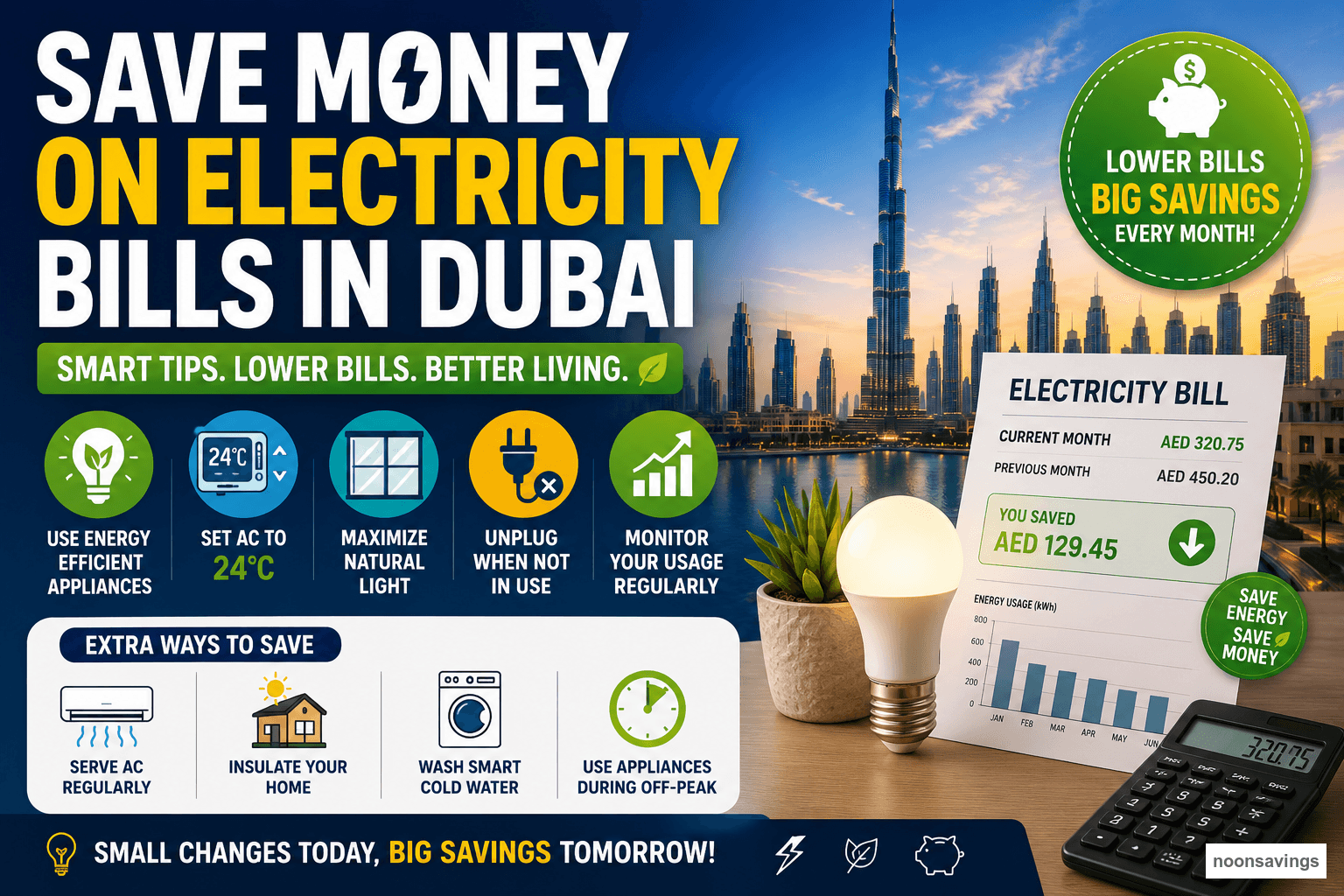
To reduce a DEWA electricity bill in Dubai, start with the load that normally uses the most power: cooling. Set the AC to 24°C or higher where comfortable, keep filters clean, close doors and windows while cooling, then use your DEWA data to see whether the change is actually reducing daily consumption. DEWA says that raising the thermostat by one degree can reduce cooling consumption by up to 5%; results vary by home, equipment and outdoor conditions.
Before buying a smart device or replacing an appliance, review consumption through DEWA Smart Living and compare your home with similar properties. This guide explains the biggest practical levers, what the tariff structure means, and which upgrades deserve attention. For the wider household budget, see our Dubai money-saving guide.
Start Here: Three Checks That Usually Find the Biggest Waste
- Check the pattern first: Use DEWA Smart Living to review your consumption and compare it with similar homes. Look for unusually high usage on days when you are away or sleeping.
- Fix cooling basics: Use a sensible thermostat setting, clean AC filters regularly during summer, and keep cooled rooms sealed. See DEWA's cooling guidance for the official recommendations.
- Identify always-on loads: Check water-heater settings, old appliances, lights and devices left on standby before spending money on major upgrades.
What is the DEWA Tariff Structure?
Electricity in Dubai is supplied by the Dubai Electricity and Water Authority (DEWA). Billing is calculated using a slab tariff system, meaning that the unit rate per kilowatt-hour (kWh) increases as total monthly consumption crosses specific volume thresholds.
Residential electricity tariffs are divided into slab categories:
- Slab 1 (0 – 2,000 kWh): Charged at the baseline rate per kWh.
- Slab 2 (2,001 – 4,000 kWh): Charged at a moderate increment per kWh.
- Slab 3 (4,001 – 6,000 kWh): Charged at a higher tier rate.
- Slab 4 (Above 6,000 kWh): Charged at the top-tier rate per kWh.
DEWA bills residential electricity using consumption slabs, so the unit rate rises as monthly usage moves into higher bands. DEWA's current tariff table lists the residential bands as 0-2,000, 2,001-4,000, 4,001-6,000 and more than 6,000 kWh. Check DEWA's current slab tariff before estimating a bill: the fuel surcharge can change monthly and VAT and other applicable charges can affect the final amount. Lower consumption is still useful even if you do not cross a slab boundary.
Why Reducing Electricity Consumption Matters
Managing household electricity draw provides immediate and cumulative advantages:
- Direct Cost Savings: Keeping monthly kWh consumption within lower slabs dramatically lowers the total bill.
- Preventive Appliance Care: Running cooling units and appliances efficiently reduces mechanical wear and extends equipment lifespan.
- Environmental Responsibility: Lower overall power demand reduces natural resource consumption and lowers greenhouse gas emissions.
- Better Rent Budget Alignment: Reducing monthly overheads aids in optimising overall housing costs in Dubai, leaving more operational headroom for other financial goals.
How We Evaluated Energy-Saving Tactics
We evaluated these energy-reduction methods using strict analytical criteria to ensure safety, practicality, and maximum financial return:
- Official Utility Documentation: Tariff details and smart meter capabilities sourced directly from DEWA operational frameworks.
- Measurable Consumption Impact: Prioritising actions that yield verifiable reductions in monthly kWh usage.
- Ease of Implementation: Distinguishing between zero-cost behavioral tweaks and low-cost hardware enhancements.
- Property Applicability: Comparing options suitable for tenant-occupied apartments versus owner-occupied villas.
- Return on Investment: Assessing how quickly energy-saving purchases pay for themselves through utility bill reductions.
Quick Savings Comparison
| Focus Area | Primary Strategy | Estimated Impact on Bill | Complexity | Upfront Cost |
|---|---|---|---|---|
| Air Conditioning | Set thermostat to 24°C & clean filters | High (30%–40% of bill) | Low | Free |
| Thermostat Control | Install programmable/smart thermostats | Moderate to High | Medium | Moderate |
| Water Heating | Use timers; turn off during summer | Moderate | Low | Free to Low |
| Lighting & Electronics | Switch to LED & turn off standby power | Low to Moderate | Low | Low |
Core Strategy 1: Air Conditioning Efficiency Optimisation
Best For
Households in both apartments and villas seeking immediate, significant utility cost reductions without upfront expenditure.
Overview
Air conditioning accounts for up to 60% or more of total household electricity consumption in Dubai during peak warmer months. Small adjustments in temperature set-points and maintenance habits deliver substantial reductions in power draw.
Key Features
- Thermostat Baseline: Keeping temperatures set at 24°C or higher when home.
- Filter Maintenance: Cleaning air filters every two to four weeks to maintain uninterrupted airflow.
- Zoned Cooling: Shutting vents and doors in unused rooms to prevent cooling unnecessary space.
Pros
- Delivers immediate reduction in monthly kWh consumption.
- Requires zero capital investment for simple setting changes.
- Extends the lifespan of central and split AC compressors.
Cons
- Requires initial adjustments to indoor comfort preferences.
- Inefficient building insulation can reduce overall performance.
Who Should Choose It?
Every resident in Dubai, regardless of accommodation type, should prioritise AC optimisation as their primary cost-control measure.
Who Should Avoid It?
Residents with specialized health requirements needing precise, ultra-low temperatures may need to moderate these settings carefully.
Verdict
Optimising air conditioning operation is the single most impactful step any resident can take to prevent utility bill spikes.
Core Strategy 2: Smart Thermostats and Automation
Best For
Property owners and long-term tenants who want automated, scheduled temperature management.
Overview
Smart thermostats adjust indoor cooling based on occupation schedules, preventing air conditioners from cooling empty rooms at maximum intensity. They connect to home Wi-Fi networks and allow remote tracking of energy consumption trends.
Key Features
- Automated Scheduling: Automatically raises temperatures during work hours and lowers them before arrival.
- Remote Control: Adjust cooling settings using smartphone software from anywhere.
- Usage Analytics: Tracks daily power usage patterns to highlight peak consumption hours.
Pros
- Eliminates manual thermostat management error.
- Prevents unnecessary cooling when properties are unoccupied.
- Provides clear diagnostic data on AC operational efficiency.
Cons
- Involves initial purchasing and potential installation fees.
- May require landlord approval in certain rented apartments.
Who Should Choose It?
Occupants of larger apartments or villas who spend significant time away from home during the day.
Who Should Avoid It?
Short-term tenants with non-standard AC systems where wall modifications are restricted.
Verdict
Smart control devices provide sustained long-term savings by taking human oversight out of daily cooling routines.
Core Strategy 3: Strategic Appliance and Water Heater Usage
Best For
Families and multi-occupant homes seeking to streamline routine domestic energy consumption.
Overview
Major appliances like washing machines, dishwashers, and water heaters represent consistent baselines of electrical load. Managing when and how these units operate stops continuous grid draw.
Key Features
- Water Heater Management: Switching off storage water heaters during warmer months when ambient water temperatures are naturally high.
- Full Load Operation: Running dishwashers and washing machines only when fully loaded.
- Cold Water Washing: Using eco-mode and cold-water wash cycles whenever possible.
Pros
- Easy to integrate into standard weekly routines.
- Reduces unnecessary wear on water heater heating elements.
- Lower hot water demand reduces overall consumption.
Cons
- Requires coordination among all household members.
- Eco-cycles may take longer to finish laundry or dishes.
Who Should Choose It?
Medium to large households with frequent laundry and dishwashing requirements.
Who Should Avoid It?
Individuals living in studios with instantaneous water heaters that draw power only when taps are turned on.
Verdict
Targeting appliance efficiency provides steady, incremental cost reductions that support overall energy management goals.
Core Strategy 4: Lighting and Standby Power Elimination
Best For
Residents looking to modernize household fixtures and clear constant background energy leaks.
Overview
While less demanding than air conditioning, traditional incandescent or halogen lighting emits heat that forces AC units to work harder. In addition, devices left on standby pull consistent power around the clock.
Key Features
- LED Transition: Replacing outdated bulbs with high-efficiency light-emitting diodes (LEDs).
- Smart Power Strips: Cutting power completely to televisions, sound systems, and gaming consoles when turned off.
- Natural Light Usage: Utilizing daylight effectively during morning and early afternoon hours.
Pros
- LED bulbs draw up to 80% less power than traditional bulbs.
- Reduces internal heat generation within living spaces.
- Prevents hidden background electrical costs.
Cons
- Replacing every bulb in a large property requires upfront spending.
- LED fixtures must be selected carefully to match fixture sockets.
Who Should Choose It?
Anyone occupying a property with legacy halogen spotlights or numerous background electronics.
Who Should Avoid It?
Properties already fully outfitted with modern, energy-efficient LED fixtures.
Verdict
Upgrading lighting and eliminating phantom power draw is a low-effort upgrade that keeps base electricity consumption low.
Comprehensive Energy Reduction Matrix
| Efficiency Measure | Implementation Cost | Potential Savings | Applicability for Tenants | Maintenance Requirement |
|---|---|---|---|---|
| AC Temperature set to 24°C+ | Nil | High | Universal | None |
| AC Filter Cleaning | Nil | Moderate to High | Universal | Monthly |
| Smart Thermostat Installation | Moderate | High | Landlord Approval Recommended | Low |
| Switching off Water Heaters | Nil | Moderate | Universal | Seasonal |
| Complete LED Upgrade | Low to Moderate | Low to Moderate | Universal | Very Low |
| Unplugging Standby Electronics | Nil | Low | Universal | Continuous Habit |
Things to Consider Before Upgrading Equipment
Before spending money on energy-efficient home upgrades, evaluate your residential context:
- Tenancy Duration: If your lease expires within a year, focus on zero-cost behavioral changes rather than fixed hardware investments.
- Building Insulation Quality: Poor window sealing or leaky balcony doors allow cool air to escape. Addressing drafts with weather strips often yields better results than upgrading thermostats alone. For context on choosing energy-efficient accommodation initially, review criteria for selecting budget-friendly residential areas.
- DEWA Smart App Monitoring: Make use of official smart meter tracking tools provided through utility portals. Monitoring daily usage graphs helps you spot unexplained consumption spikes early.
- Broader Household Budgeting: Combine utility saving techniques with other practical household adjustments, such as practical household savings tips, to manage living costs across the board.
Frequently Asked Questions
What is the ideal thermostat setting for saving energy in Dubai?
Setting your thermostat to 24°C provides an optimal balance between indoor comfort and electrical efficiency. Lowering the temperature to 20°C or below forces the compressor to run continuously, increasing power usage significantly.
Does turning off the AC completely when leaving for work save money?
For short absences (such as a standard workday), turning off the AC completely can allow indoor temperatures and humidity to rise significantly. The AC must then run at maximum capacity for hours to restore comfort. Setting the temperature to 27°C or 28°C while away is usually more efficient than shutting it off entirely.
How often should AC filters be cleaned?
AC filters should be checked and cleaned every two to four weeks during warmer months. Dust build-up restricts airflow, forcing the system to work harder and consume more power.
Why is my DEWA bill high during winter months?
High winter bills are often driven by continuous water heater usage, outdoor lighting, or leaving appliances plugged in. Checking for water leaks or incorrect meter readings can help identify non-AC causes.
Does using a ceiling fan actually help lower electricity bills?
Yes. Ceiling fans circulate air, creating a wind-chill effect that makes a room feel up to two degrees cooler. This allows you to raise the main AC thermostat setting without sacrificing comfort. Remember to turn fans off when leaving the room, as they cool people, not space.
What is the DEWA Away Mode feature?
DEWA offers an Away Mode tool through its digital portal. It allows residents to monitor home energy usage through automated alerts if power or water consumption spikes while they are traveling.
Should water heaters be left on continuously?
Leaving storage water heaters on 24 hours a day consumes unnecessary power. Turning heaters on 30 to 45 minutes before use—or installing a programmable timer—cuts baseline energy draw significantly.
How much can switching to LED bulbs really save?
LED bulbs consume up to 80% less energy than standard incandescent or halogen options and generate far less heat, indirectly reducing the load on your cooling system.
Disclaimer
This guide is prepared for informational and educational purposes only. Actual electricity bill savings vary depending on individual property sizes, building insulation quality, specific appliance efficiency ratings, household size, and seasonal climate conditions. Readers should review their official utility account statements for precise consumption metrics.
Planning tool: Use our Savings Goal Calculator to turn the monthly utility savings you achieve into a larger household saving target.
Final Thoughts
Lowering your utility bill in Dubai does not require sacrificing personal comfort. By applying practical air conditioning habits, maintaining clean filters, eliminating standby electronic loads, and leveraging smart meter monitoring, households can keep energy consumption within lower billing slabs consistently. Small, consistent daily choices compound into substantial annual savings, helping you maintain tighter control over your total living costs in the UAE.

Written byZaib Azhar✓
Zaib Azhar is a UAE-based web developer, photographer, and savings enthusiast who has been living in the UAE for over 12 years. Passionate about smart budgeting, cashback strategies, affordable living, and digital solutions, he shares practical insights to help residents save money and make informed financial decisions. With experience in web development, online research, and content creation, Zaib combines technology, creativity, and real-life UAE market knowledge to create useful guides on budgeting, banking offers, consumer deals, and cost-of-living tips.
View all articles by Zaib Azhar →