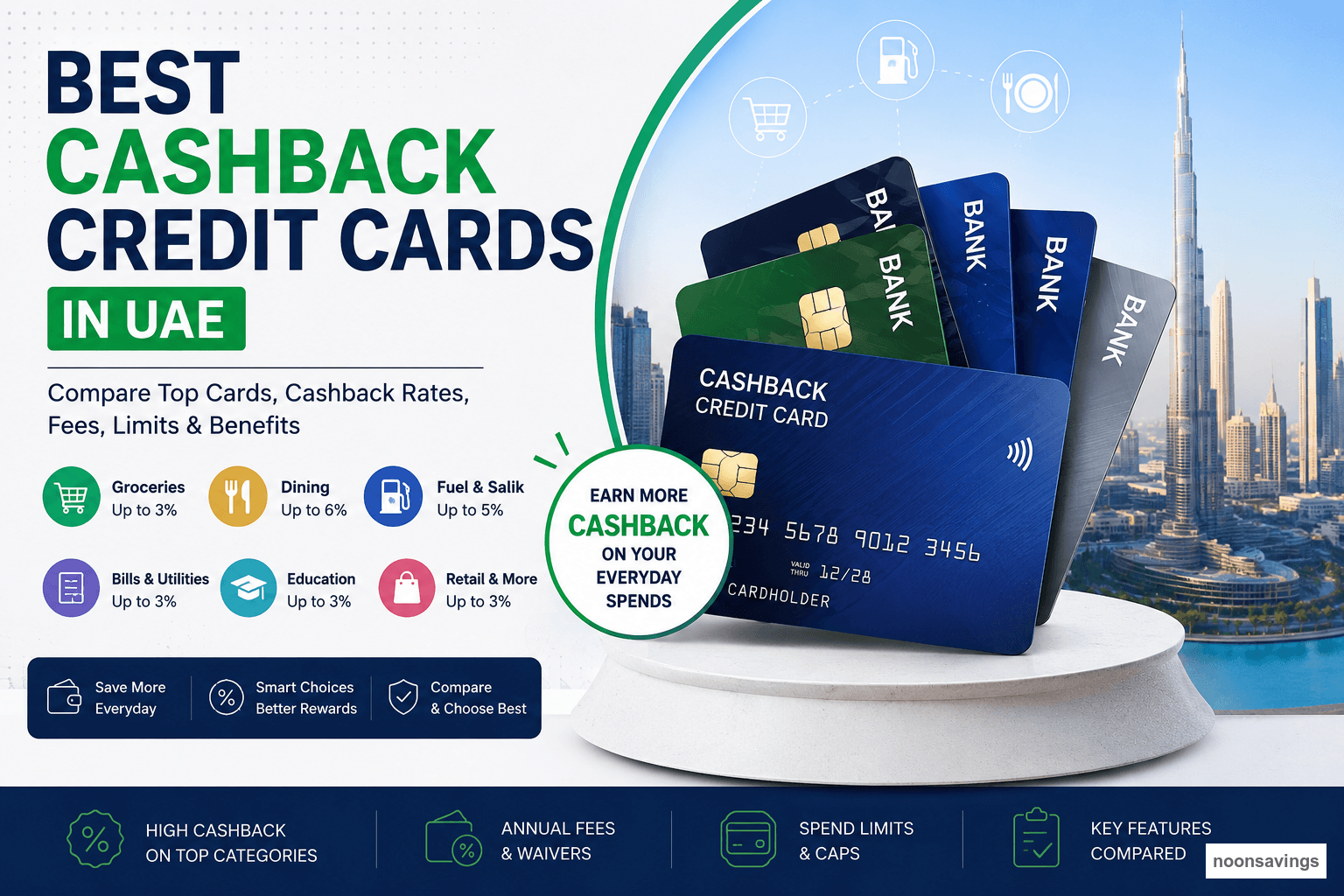
Best Cashback Credit Cards in UAE

Written byZaib Azhar✓
August 12, 202639 min read
Cashback credit cards are among the simplest ways to earn something back from spending you were already planning to make.
But choosing the best cashback credit card in the UAE is not as simple as finding the card advertising the largest percentage.
A card offering 6% cashback may be excellent for one household and poor value for another. The result depends on where you spend, how much you spend, minimum-spend requirements, monthly cashback caps, excluded transactions and annual fees.
For example, ADCB currently advertises 6% cashback on dining with its 365 Cashback Credit Card, while Mashreq advertises 5% on local and international dining with its Cashback Credit Card. Citi takes a different approach, offering 3% on non-AED spending, 2% on groceries and supermarkets, and 1% on other eligible spending.
Those headline percentages are useful, but they do not tell the whole story.
This guide compares major cashback credit cards available in the UAE using their banks' published information and focuses on a more practical question:
Which cashback card gives you the most useful return for the way you actually spend money?
Quick answer: There is no single best cashback credit card for everyone in the UAE. ADCB 365 can be attractive for households with significant dining and everyday spending that can meet its monthly spend requirement. Mashreq Cashback stands out for having no annual fee and no minimum spend to earn cashback. Citi Cashback offers a relatively straightforward structure across groceries, international and other eligible spending. Other cards can make more sense for specific spending patterns. Always compare the effective cashback you are likely to receive rather than choosing a card based only on its highest advertised rate. For a broader choice across cashback, travel and low-fee products, see our guide to the best credit cards in UAE.
How We Compare Cashback Credit Cards
A useful cashback comparison needs to look beyond the largest number displayed on a bank's product page.
For each card, we consider:
- cashback rates
- spending categories
- minimum monthly spending
- cashback caps
- annual fee
- salary eligibility
- excluded or lower-earning transactions
- simplicity of the cashback structure
- suitability for common UAE household expenses
We also distinguish between headline cashback and realistic cashback.
Suppose Card A advertises 6% cashback while Card B advertises 3%.
Card A is not automatically twice as rewarding.
The 6% may apply only to one category, require a substantial minimum monthly spend or be subject to a cap. Card B may offer cashback across a much larger proportion of your normal spending.
The correct comparison therefore depends on your own spending pattern.
Information Can Change
Credit-card benefits are not permanent.
Banks can change:
- cashback rates
- annual fees
- eligibility requirements
- spending thresholds
- cashback caps
- excluded transactions
- promotional benefits
Last reviewed: August 2026. The comparisons below use official product pages from ADCB, Mashreq, Citi and Dubai Islamic Bank. Rates, category definitions, caps, fees, eligibility and offers can change, so verify the latest Key Facts Statement and terms with the issuing bank before applying.
Best Cashback Credit Cards in UAE Compared
Here is a quick comparison of several major cashback cards.
| Card | Notable Cashback | Minimum Spend to Earn Cashback | Annual Fee | Minimum Salary |
|---|---|---|---|---|
| ADCB 365 Cashback | 6% dining, 5% fuel & Salik, 3% groceries | AED 5,000/month | Free first year; AED 383.25 from second year | Check current ADCB eligibility |
| Mashreq Cashback | 5% dining, 1% international, up to 1% other local spending | No minimum spend | Free for life | AED 5,000/month |
| Citi Cash Back | 3% non-AED, 2% groceries, 1% other eligible spending | No minimum spend to earn cashback | Free first year; AED 300 thereafter unless annual spend requirement is met | AED 8,000/month |
| DIB Consumer Cashback Reward | Up to 3% on eligible everyday spending | AED 3,000/month | AED 210 incl. VAT | AED 5,000/month |
Important: This table is a high-level comparison, not a complete description of each card's terms. Cashback categories, caps, qualifying transactions and exclusions can materially affect the actual return.
Official card information:
- ADCB 365 Cashback Credit Card
- Mashreq Cashback Credit Card
- Citi Cash Back Credit Card
- DIB Consumer Cashback Reward Card
ADCB 365 Cashback Credit Card
The ADCB 365 Cashback Credit Card is structured around everyday household spending.
According to ADCB's current card information, it offers:
- 6% cashback on dining, including online orders
- 5% cashback on fuel and Salik
- 5% cashback on eligible home digital entertainment subscriptions
- 5% cashback on eligible AI-powered subscriptions
- 3% cashback on groceries and supermarkets
- up to 1% cashback on other retail spending
The card currently allows up to AED 1,000 cashback per month.
However, there is an important condition:
You need at least AED 5,000 of qualifying purchases in a calendar month to become eligible for cashback for that month.
That requirement significantly changes who should consider the card.
ADCB 365 at a Glance
| Feature | Current Published Detail |
|---|---|
| Dining | 6% |
| Fuel & Salik | 5% |
| Groceries | 3% |
| Selected entertainment subscriptions | 5% |
| Selected AI subscriptions | 5% |
| Other retail spending | Up to 1% |
| Minimum monthly spend for cashback | AED 5,000 |
| Maximum monthly cashback | AED 1,000 |
| First-year annual fee | No annual fee |
| Annual fee from second year | AED 383.25 incl. VAT |
Who May Benefit Most?
ADCB 365 becomes particularly interesting for households that already spend at least AED 5,000 per month on the card and have substantial spending across categories such as:
- dining
- fuel
- Salik
- groceries
Imagine a household regularly spending on supermarket shopping, eating out, food delivery and commuting.
The elevated category rates can potentially produce meaningful cashback.
But someone spending only AED 2,000–3,000 per month should pay particular attention to the AED 5,000 qualifying-spend requirement.
A high cashback percentage has little value if you do not qualify to receive it.
The Annual Fee Matters
The card currently has no annual fee for the first year, while ADCB lists an annual fee of AED 383.25 including VAT from the second year.
That means you should eventually compare:
Annual cashback earned − annual fee = approximate net annual reward
If you earn AED 1,000 in cashback but pay approximately AED 383 in annual fees, your net benefit before considering any other costs is substantially lower than the headline AED 1,000.
Mashreq Cashback Credit Card
The Mashreq Cashback Credit Card takes a different approach.
Its biggest attraction is simplicity around fees and qualifying spend.
Mashreq currently advertises the card as:
Free for life
There is also no minimum spending requirement to start earning cashback.
According to Mashreq's published card information, the cashback structure includes:
- 5% cashback on local and international dining
- 1% cashback on other international spending
- up to 1% cashback on other local spending
- 0.15% cashback on categories including government payments, utilities, education, charity, fuel, rental and telecom spending
Mashreq Cashback at a Glance
| Feature | Current Published Detail |
|---|---|
| Dining | 5% |
| Other international spending | 1% |
| Other local spending | Up to 1% |
| Government/utilities/education/fuel/rent/telecom | 0.15% |
| Minimum spend to earn cashback | None |
| Annual fee | Free for life |
| Minimum monthly income | AED 5,000 |
Why the No-Minimum-Spend Rule Matters
Consider someone who spends AED 2,500 per month.
A card requiring AED 5,000 monthly spending before any cashback becomes payable may not suit that person.
Mashreq's lack of a minimum-spend requirement makes it more accessible for people whose monthly credit-card spending fluctuates.
You should still examine where that AED 2,500 is spent.
The card's strongest advertised cashback category is dining.
Other categories can earn substantially less.
Watch the Low-Rate Categories
The 5% dining rate is attractive.
But Mashreq currently lists only 0.15% cashback for several categories that can represent significant UAE household expenses, including:
- fuel
- utilities
- education
- telecom
- rent
- government payments
This is a good example of why selecting a cashback card based only on its largest advertised percentage can be misleading.
Someone spending heavily on dining may see a very different result from someone whose card is primarily used for school fees, fuel and utilities.
Citi Cash Back Credit Card
The Citi Cash Back Credit Card offers one of the easier cashback structures to understand.
Citi currently advertises:
- 3% cashback on non-AED spending
- 2% cashback on grocery and supermarket spending
- 1% cashback on other eligible spending
Citi also states that there is no minimum spending requirement to earn cashback.
Citi Cash Back at a Glance
| Feature | Current Published Detail |
|---|---|
| Non-AED spending | 3% |
| Groceries & supermarkets | 2% |
| Other eligible spending | 1% |
| Minimum spend to earn cashback | None |
| First-year annual fee | No annual fee |
| Annual fee thereafter | AED 300 unless waiver requirement is met |
| Annual spend for fee waiver | AED 9,000 |
| Minimum monthly income | AED 8,000 |
Citi states that cashback has no general cap up to the card's monthly credit limit, although its terms and excluded transactions still apply.
A Useful Option for Simple Cashback
The card may appeal to someone who prefers a relatively straightforward structure rather than tracking many different bonus categories.
For example, a household using the card for:
- supermarket shopping
- ordinary retail purchases
- foreign-currency transactions
can understand fairly easily which cashback rate applies.
Consider the Annual Fee From Year Two
Citi currently waives the annual fee in the first year.
From the second year onwards, Citi states that the AED 300 annual fee is waived if the cardholder meets the required AED 9,000 annual spend.
For someone using the card regularly, AED 9,000 per year may be achievable.
But it should still be considered before applying.
Dubai Islamic Bank Consumer Cashback Reward Card
For consumers who prefer an Islamic banking product, the Dubai Islamic Bank Consumer Cashback Reward Card is another option worth comparing.
DIB currently advertises:
- up to 3% cashback
- cashback on everyday categories including supermarkets, hypermarkets, bills and fuel
- AED 5,000 minimum salary
However, an important change applies to the card.
DIB states that from 10 May 2025, Consumer Cashback Reward Card customers need to make at least AED 3,000 in monthly retail purchases within the statement cycle to qualify for cashback.
DIB also lists the annual fee as AED 210 including VAT.
DIB Consumer Cashback Reward at a Glance
| Feature | Current Published Detail |
|---|---|
| Cashback | Up to 3% |
| Relevant categories | Supermarkets, hypermarkets, bills, fuel and other eligible spending |
| Minimum monthly retail spend for cashback | AED 3,000 |
| Annual fee | AED 210 incl. VAT |
| Minimum salary | AED 5,000 |
The card can therefore be worth investigating for someone looking for an Islamic cashback option, but the minimum-spend requirement and annual fee should be included when calculating the actual annual benefit.
Quick Comparison: Which Card Looks Strongest for What?
The cards begin to look quite different when compared by use case.
| Spending Pattern | Card Worth Comparing Closely | Main Reason |
|---|---|---|
| Heavy dining spending | ADCB 365 | 6% published dining cashback |
| Moderate dining spending | Mashreq Cashback | 5% dining with no minimum spend |
| Fuel & Salik | ADCB 365 | 5% published rate |
| Grocery spending | ADCB 365 / Citi / DIB | Different rates and qualifying requirements |
| Foreign-currency spending | Citi Cash Back | 3% published non-AED cashback |
| Lower monthly card spending | Mashreq / Citi | No minimum spend to earn cashback |
| Avoiding annual fees | Mashreq Cashback | Free-for-life annual fee structure |
| Islamic cashback option | DIB Consumer Cashback Reward | Islamic banking cashback product |
| High monthly household spending | ADCB 365 | Higher category rates if qualifying spend is met |
This does not mean the card named in each row is automatically the best choice.
The next step is to calculate how the cashback structure interacts with your actual monthly spending.
How Cashback Credit Cards Actually Work
Cashback sounds simple:
Spend money → receive a percentage back.
In practice, there are several variables.
A bank may offer different cashback percentages depending on:
- merchant category
- transaction type
- domestic vs international spending
- monthly spending level
- promotional eligibility
There may also be:
- minimum monthly spend
- monthly cashback caps
- annual fees
- excluded transactions
- lower cashback rates for certain categories
Merchant Categories Matter
Credit-card issuers generally identify transactions using merchant category information.
That means what you consider a "grocery purchase" does not necessarily guarantee that the bank's system will classify the merchant under its eligible supermarket category.
The same issue can affect:
- dining
- fuel
- travel
- online shopping
- utilities
Always read the bank's cashback terms rather than assuming every transaction at a particular type of business will receive the headline rate.
Headline Cashback vs Effective Cashback
This is the concept that matters most when comparing cashback cards.
Suppose Card A offers:
6% cashback
while Card B offers:
2% cashback
Card A appears clearly superior.
But imagine the 6% applies only to dining, while most of your monthly spending is:
- groceries
- fuel
- school fees
- utilities
- telecom
- general shopping
Your overall cashback rate may be much lower than 6%.
Calculate Cashback Across Your Entire Monthly Spend
Suppose you spend AED 5,000 per month:
| Category | Monthly Spend |
|---|---|
| Groceries | AED 1,500 |
| Dining | AED 500 |
| Fuel & Salik | AED 700 |
| Utilities & telecom | AED 600 |
| General retail | AED 1,200 |
| Other | AED 500 |
| Total | AED 5,000 |
Now apply each card's actual eligible cashback rates to those categories.
Then calculate:
Total cashback received ÷ total card spending × 100
That gives you an approximate effective cashback rate.
This number is much more useful than the largest percentage printed on the card's marketing page.
Why Minimum Spend Can Change the Winner
Consider two hypothetical cards.
Card A
- up to 6% cashback
- AED 5,000 minimum monthly spend
Card B
- up to 5% cashback
- no minimum monthly spend
If you regularly spend AED 6,000 each month, Card A may deserve serious consideration.
If you normally spend AED 3,000, Card B may be far more useful.
The wrong response would be to spend an extra AED 2,000 simply to unlock cashback.
Never increase unnecessary spending to qualify for a credit-card reward.
If you spend AED 2,000 you did not need to spend in order to earn AED 100 cashback, you have not saved AED 100.
You have spent an unnecessary AED 1,900 net.
The Best Cashback Card Depends on Your Spending
Before comparing cards, take your last two or three months of spending and divide it into categories.
For example:
| Category | Your Monthly Spend |
|---|---|
| Groceries | AED ___ |
| Dining | AED ___ |
| Fuel | AED ___ |
| Salik | AED ___ |
| Utilities | AED ___ |
| Telecom | AED ___ |
| School/education | AED ___ |
| Online shopping | AED ___ |
| Travel | AED ___ |
| International/non-AED | AED ___ |
| General retail | AED ___ |
| Other | AED ___ |
| Total | AED ___ |
Only then compare cards.
Someone spending AED 2,000 per month on groceries should optimise differently from someone spending AED 2,000 on dining.
Likewise, a family paying substantial school expenses should not assume a dining-focused cashback card is the best option simply because it advertises the highest cashback percentage.
The best cashback credit card is therefore not necessarily the card with the highest rate.
It is the card that produces the highest realistic net cashback from spending you were already going to make.
Best Cashback Credit Card for Groceries in UAE
Groceries are one of the most predictable expenses for many UAE households, which makes supermarket spending a particularly useful category for cashback.
Among the cards compared in this guide, the published grocery rates include:
| Card | Grocery / Supermarket Cashback | Important Condition |
|---|---|---|
| ADCB 365 Cashback | 3% | AED 5,000 minimum monthly qualifying purchases |
| Citi Cash Back | 2% | No minimum spend to earn cashback |
| DIB Consumer Cashback Reward | 3% | AED 3,000 minimum monthly retail purchases |
| Mashreq Cashback | Standard local-spend structure applies | Check merchant/category eligibility |
The highest percentage alone should not determine the winner.
ADCB 365 for Groceries
ADCB currently offers 3% cashback on grocery and supermarket spending through its 365 Cashback Credit Card.
However, you need at least AED 5,000 in qualifying purchases during the calendar month to unlock cashback.
ADCB also caps total cashback at AED 1,000 per month.
This can make sense for a household that already puts substantial everyday spending on one card.
But if your total monthly card spending regularly stays below AED 5,000, the headline 3% grocery rate becomes much less relevant.
Citi Cash Back for Groceries
Citi currently offers 2% cashback on grocery and supermarket spending with no minimum spending requirement to start earning cashback.
The percentage is lower than ADCB's published grocery rate, but the lack of a monthly qualifying-spend threshold can make Citi more practical for someone with lower or irregular card spending.
DIB Consumer Cashback Reward for Groceries
DIB currently offers 3% cashback on supermarket and hypermarket purchases, with a category cashback cap of AED 300 per month.
The bank states that customers must make at least AED 3,000 in monthly retail purchases within the statement cycle to qualify for cashback.
For consumers specifically looking for an Islamic cashback product, this makes DIB particularly relevant to the comparison.
Which Is Better for Groceries?
Consider someone spending:
AED 1,500 per month on groceries
At the headline rates:
- 3% = AED 45 per month
- 2% = AED 30 per month
The difference is only:
AED 15 per month
or:
AED 180 per year
That difference can easily become less important than:
- annual fees
- minimum-spend requirements
- cashback earned on other categories
This is why you should compare the whole card, not just its supermarket rate.
Best Cashback Credit Card for Dining in UAE
Dining is one category where the differences between cashback cards become much larger.
Among the cards compared here, ADCB and Mashreq currently advertise particularly strong dining rates.
| Card | Published Dining Cashback |
|---|---|
| ADCB 365 Cashback | 6% |
| Mashreq Cashback | 5% |
| Citi Cash Back | Standard eligible-spend rate |
| DIB Consumer Cashback Reward | Check applicable transaction category |
ADCB 365: 6% Dining Cashback
ADCB currently advertises 6% cashback on dining, including online food orders.
For someone who frequently spends on:
- restaurants
- cafés
- eligible online food orders
this can produce meaningful cashback.
But remember the AED 5,000 minimum monthly qualifying-purchase requirement.
Mashreq Cashback: 5% Dining Without a Minimum Spend
Mashreq currently offers 5% cashback on local and international dining.
Unlike ADCB 365, Mashreq states there is no minimum spend required to start earning cashback.
The card is also currently advertised as free for life.
This creates an interesting comparison.
Someone spending significantly more than AED 5,000 per month may prefer ADCB's broader elevated categories.
Someone spending much less but regularly dining out may find Mashreq's structure easier to use.
Example: AED 800 Monthly Dining Spend
At the headline rates:
ADCB 365
AED 800 × 6% = AED 48
Mashreq Cashback
AED 800 × 5% = AED 40
Difference:
AED 8 per month
The extra percentage point produces only AED 8 additional cashback on AED 800 of dining.
If the customer does not meet ADCB's overall monthly qualifying-spend requirement, Mashreq could clearly produce the better practical result.
Again, effective cashback matters more than headline cashback.
Best Cashback Credit Card for Fuel and Salik
Fuel and Salik are particularly relevant expenses for UAE residents who commute regularly.
ADCB 365 currently stands out among the cards in this comparison by advertising:
- 5% cashback on fuel
- 5% cashback on Salik
ADCB changed this category from 3% to 5% effective 1 July 2026, while its grocery cashback moved from 5% to 3%.
This is another reason old credit-card comparison articles can become inaccurate quickly.
DIB Also Covers Fuel and Salik
DIB currently advertises 3% cashback on fuel spending, subject to a maximum AED 100 cashback for that category per month.
It also lists 3% cashback on Salik and Nol recharges, subject to a AED 25 monthly category cap.
The overall monthly cashback cap is AED 1,000.
Mashreq Is Less Attractive for Fuel
Mashreq's published cashback structure currently lists fuel among categories earning 0.15% cashback.
That means someone choosing Mashreq primarily because of its 5% dining rate should not assume they will receive a similar return on fuel.
Example: AED 700 Monthly Fuel and Salik
Suppose eligible spending totals AED 700.
At 5%:
AED 700 × 5% = AED 35
At 3%:
AED 700 × 3% = AED 21
At 0.15%:
AED 700 × 0.15% = AED 1.05
That is a substantial difference over a year.
If fuel and Salik represent a meaningful part of your household budget, they deserve their own line in your cashback comparison.
Best Cashback Credit Card With No Annual Fee
Annual fees can quietly reduce the real value of cashback.
Among the cards compared here, Mashreq Cashback has the clearest permanent no-annual-fee structure.
Mashreq currently states that the primary and supplementary Cashback Cards are:
Free for life
This can be particularly attractive for someone who:
- does not want to track an annual fee waiver
- has moderate monthly spending
- spends regularly on dining
- wants a relatively low-maintenance cashback card
Citi Can Also Avoid an Annual Fee
Citi Cash Back currently has no annual fee during the first year.
From year two, Citi states that the AED 300 annual fee is not charged when the customer meets its AED 9,000 minimum annual spend requirement.
AED 9,000 per year works out to an average of:
AED 750 per month
Someone using the card as their regular spending card may therefore find the threshold relatively achievable.
But this is still different from a card explicitly offered as free for life.
Best Cashback Credit Card for Lower Monthly Spending
If you spend relatively little on a credit card each month, minimum-spend requirements become particularly important.
Consider someone spending:
AED 2,500 per month
ADCB 365 requires AED 5,000 in qualifying monthly purchases to unlock cashback.
DIB Consumer Cashback Reward requires AED 3,000 in monthly retail purchases within the statement cycle.
That person would not normally meet either threshold based on the AED 2,500 example.
Mashreq and Citi, however, currently state that there is no minimum spend required to start earning cashback.
This makes them more natural candidates for lower spenders.
Don't Increase Spending to Unlock Cashback
Suppose you normally spend AED 3,500 per month.
A card requires AED 5,000.
Do not spend another AED 1,500 unnecessarily just to unlock cashback.
Cashback should reward spending that was already necessary.
It should never become a reason to consume more.
Cashback Caps and Minimum-Spend Requirements
Cashback caps are another reason advertised percentages can be misleading.
Suppose a card offers:
5% cashback
but caps the relevant reward at AED 100 per month.
Once you have earned AED 100, additional eligible spending may no longer generate the same reward during that period.
Compare the Current Structures
| Card | Minimum Spend Requirement | Cashback Cap |
|---|---|---|
| ADCB 365 | AED 5,000/month | AED 1,000/month |
| Mashreq Cashback | No minimum spend to earn cashback | Depends on applicable cashback terms/categories |
| Citi Cash Back | No minimum spend to earn cashback | No general cashback cap up to monthly credit limit, subject to terms |
| DIB Consumer Cashback Reward | AED 3,000/month | AED 1,000 total/month plus category caps |
These conditions can matter more than a 1% difference in the advertised rate.
DIB's Category Caps Are Particularly Important
DIB currently lists separate monthly cashback limits including:
| Category | Cashback | Maximum Monthly Cashback |
|---|---|---|
| Supermarkets & hypermarkets | 3% | AED 300 |
| Automobile servicing | 3% | AED 300 |
| Etisalat & du bills | 3% | AED 100 |
| Fuel | 3% | AED 100 |
| Utility bills | 3% | AED 100 |
| Salik & Nol recharges | 3% | AED 25 |
| School fees | 3% | AED 300 |
The overall monthly cashback cap is AED 1,000.
This structure could be interesting for a household with spending spread across several everyday categories.
How to Calculate Your Real Cashback
Instead of asking:
Which credit card gives the highest cashback?
ask:
Which card would have given me the most cashback on my actual spending last month?
You can calculate this yourself.
Step 1: Get Your Monthly Spending
Use a recent bank or credit-card statement.
Separate spending into:
- groceries
- dining
- fuel
- Salik
- utilities
- telecom
- school fees
- online shopping
- travel
- international spending
- general retail
- other spending
Step 2: Apply Each Card's Cashback Rates
Suppose your monthly spending looks like this:
| Category | Monthly Spend |
|---|---|
| Groceries | AED 1,500 |
| Dining | AED 800 |
| Fuel & Salik | AED 700 |
| Utilities & telecom | AED 700 |
| General retail | AED 1,000 |
| Other | AED 300 |
| Total | AED 5,000 |
Now calculate each card separately.
For illustration, using ADCB 365's currently published headline rates for eligible local spending:
Groceries
AED 1,500 × 3% = AED 45
Dining
AED 800 × 6% = AED 48
Fuel & Salik
AED 700 × 5% = AED 35
Other categories should then be calculated according to their applicable cashback rates and eligibility.
This is far more informative than simply saying:
ADCB gives up to 6%.
The household does not earn 6% on everything.
Step 3: Subtract the Annual Fee
Suppose a card generates:
AED 1,000 annual cashback
but costs:
AED 300 per year
Your simplified net reward becomes:
AED 1,000 − AED 300 = AED 700
If another no-fee card generates AED 800 cashback, the second card actually provides greater net value despite apparently earning less cashback.
Step 4: Calculate Your Effective Cashback Rate
Use:
Net annual cashback ÷ annual card spending × 100
Suppose:
- annual spending = AED 60,000
- cashback received = AED 1,800
- annual fee = AED 300
Net cashback:
AED 1,500
Effective cashback:
AED 1,500 ÷ AED 60,000 × 100 = 2.5%
That 2.5% is much more useful than the card's largest advertised cashback percentage.
Should You Pay an Annual Fee for a Cashback Card?
A credit card with an annual fee is not automatically worse than a free card.
The question is whether the additional rewards justify the fee.
Suppose:
Card A
Annual fee: AED 400 Annual cashback: AED 2,000
Net cashback:
AED 1,600
Card B
Annual fee: AED 0 Annual cashback: AED 1,200
Net cashback:
AED 1,200
Card A still provides AED 400 more value in this simplified example.
But change the spending pattern and Card B could win.
Calculate Your Fee Break-Even Point
Suppose a paid card produces approximately 1% more cashback than a free alternative.
Annual fee:
AED 400
Additional spending required for the extra 1% to recover the fee:
AED 400 ÷ 1% = AED 40,000
You would need roughly AED 40,000 of spending receiving that additional 1% advantage just to offset the AED 400 fee.
This type of calculation is much more useful than simply avoiding every card with an annual fee.
Cashback vs Rewards Points
Cashback cards are not the only rewards option available in the UAE.
Other credit cards may offer:
- airline miles
- hotel points
- bank reward points
- travel benefits
- airport lounge access
- lifestyle benefits
Cashback has one major advantage:
It is relatively easy to value.
AED 100 cashback is approximately AED 100 of monetary value credited according to the card's redemption structure.
Points can be more complicated because their value depends on how they are redeemed.
Cashback May Suit You If You Prefer
- simple rewards
- everyday savings
- predictable value
- less involvement with loyalty programmes
Points or Miles May Suit You If You
- travel frequently
- understand loyalty programmes
- can obtain good redemption value
- value travel benefits more than cash
Neither structure is universally better.
Choose according to how you actually use the rewards. If travel benefits and no annual fee matter more than everyday cashback, compare our no-annual-fee travel credit cards in UAE before applying.
Do Welcome Bonuses Matter?
Welcome offers can make a new credit card look substantially more attractive.
But they should not be the primary reason for keeping a card long term.
For example, ADCB currently advertises a AED 365 welcome bonus on its 365 Cashback Credit Card, subject to qualifying conditions.
Citi currently advertises a joining statement credit subject to its own eligibility and spending conditions.
Offers can change or expire.
When comparing cards, separate:
First-Year Value
Including:
- joining bonus
- promotional cashback
- first-year fee waiver
from:
Ongoing Value
Including:
- normal cashback
- annual fee
- normal spending requirements
- normal cashback caps
A card can look exceptional in year one and average in year two.
For an evergreen comparison, ongoing value deserves more weight than a temporary welcome promotion.
Should You Use More Than One Cashback Credit Card?
Using multiple cards can potentially increase cashback.
For example, someone might theoretically use:
- one card for groceries
- another for dining
- another for fuel
- another for travel
Mathematically, that can improve rewards.
Practically, it also creates more complexity.
You need to manage:
- multiple payment dates
- multiple statements
- minimum-spend requirements
- annual fees
- cashback caps
- different exclusions
For many consumers, one well-matched cashback card may be better than optimising every transaction across several cards.
When Multiple Cards Can Make Sense
A second card may be useful when:
- spending is high enough to justify optimisation
- categories complement each other
- annual fees do not eliminate the additional reward
- you can manage every account responsibly
- you always pay balances according to your repayment plan
Do not open additional credit cards simply to chase small cashback differences. Cashback apps can sometimes offer additional savings at selected merchants, but check the app and card terms before assuming rewards can be combined; our UAE cashback apps comparison explains the trade-offs.
Credit Card Interest Can Wipe Out Your Cashback
This is the most important financial point in the entire comparison.
Cashback is valuable only when it does not encourage expensive borrowing.
Suppose you earn:
AED 100 cashback
but incur:
AED 200 in finance charges or other avoidable card costs
The rewards have not saved you money.
You are AED 100 worse off before considering anything else.
Cashback cards are therefore most useful when they are treated primarily as a payment method, not as a reason to carry unaffordable balances.
Do Not Spend for Rewards
A 5% cashback rate means:
Spend AED 100 → receive approximately AED 5 back on an eligible transaction.
You still spent approximately:
AED 95 net
You did not make AED 5.
This sounds obvious, but rewards programmes are designed to make spending feel more rewarding.
The strongest cashback strategy remains:
Earn rewards on purchases you would have made anyway.
Common Cashback Credit Card Mistakes
Choosing the Highest Advertised Percentage
A 6% headline rate may apply to only one part of your spending.
Calculate the whole monthly result.
Ignoring Minimum Spend
If a card requires AED 5,000 per month and you normally spend AED 3,000, the card may not suit you.
Ignoring Annual Fees
Compare:
cashback earned − annual fee
rather than cashback alone.
Ignoring Cashback Caps
High spend does not always continue earning rewards indefinitely.
Check both:
- overall cashback caps
- individual category caps
Assuming Every Merchant Qualifies
Cashback categories are generally determined according to the transaction and merchant classification used by the card network and issuer.
Check the bank's terms.
Spending More to Reach a Threshold
Never turn unnecessary spending into a cashback strategy.
Focusing Too Much on Welcome Offers
A one-time joining bonus should not outweigh several years of poor ongoing value.
Carrying Expensive Debt for Cashback
Rewards can quickly become irrelevant if finance charges exceed what you earn.
How to Choose the Right Cashback Card
You can reduce the decision to a relatively simple process.
Step 1: Calculate Your Normal Monthly Card Spending
Do not estimate what you could spend.
Use what you already spend.
Step 2: Identify Your Largest Categories
For example:
- groceries
- dining
- fuel
- utilities
- school fees
Step 3: Remove Cards With Unrealistic Requirements
If you spend AED 3,000 monthly, be cautious about a card requiring AED 5,000 monthly spending to unlock cashback.
Step 4: Calculate Expected Cashback
Apply the actual category rates to your spending.
Step 5: Apply Cashback Caps
Do not calculate rewards beyond the applicable limits.
Step 6: Subtract Annual Fees
Calculate net annual cashback.
Step 7: Check Official Terms
Before applying, verify:
- eligibility
- minimum salary
- annual fee
- cashback rates
- minimum spend
- category definitions
- exclusions
- cashback caps
with the issuing bank.
Only then should you decide.
Our Comparison by Spending Profile
There is no universal winner, but the cards can be narrowed down according to different spending patterns.
| Your Spending Profile | Card to Compare Closely | Why |
|---|---|---|
| High dining + fuel spending | ADCB 365 | 6% dining and 5% fuel/Salik |
| Dining-focused, lower overall spend | Mashreq Cashback | 5% dining with no minimum spend |
| Grocery + general spending | Citi Cash Back | Simple 2% grocery / 1% other eligible spend structure |
| International non-AED spending | Citi Cash Back | 3% non-AED cashback |
| Want no annual fee | Mashreq Cashback | Free-for-life structure |
| Islamic cashback preference | DIB Consumer Cashback Reward | Up to 3% across several everyday categories |
| School fees + utilities + fuel | DIB Consumer Cashback Reward | Published 3% categories, subject to caps and eligibility |
| AED 5,000+ varied household spending | ADCB 365 | Elevated rates across several everyday categories |
This table should be treated as a shortlisting tool, not a recommendation to apply for a particular card.
Your own spending calculation should make the final decision.
Which Cashback Credit Card Is Best in UAE?
After comparing the cards, there is no single cashback credit card that is best for every UAE resident.
The strongest choice changes according to:
- how much you spend each month
- where you spend
- whether you consistently meet minimum-spend requirements
- whether you want to pay an annual fee
- whether your spending is concentrated in one category
- whether you prefer conventional or Islamic banking
The easiest way to narrow the options is to compare them by spending profile.
Best Overall for Higher Household Spending: ADCB 365 Cashback
The ADCB 365 Cashback Credit Card is particularly competitive for households that already spend AED 5,000 or more in qualifying purchases each month.
Its current cashback structure includes:
- 6% on dining and eligible online food orders
- 5% on fuel and Salik
- 5% on eligible home digital entertainment subscriptions
- 5% on eligible AI-powered subscriptions
- 3% on groceries and supermarkets
- up to 1% on other retail spending
The maximum cashback is AED 1,000 per month.
The important limitation is the AED 5,000 minimum monthly qualifying-spend requirement. If you do not reach it, the attractive category rates become much less useful.
The card is currently free for the first year, after which ADCB lists an annual fee of AED 383.25 including VAT.
Best suited to: Households already spending AED 5,000+ monthly, particularly when dining, fuel, Salik and groceries make up a significant share of spending.
Best for Dining Without a Minimum Spend: Mashreq Cashback
Mashreq Cashback is easier to use for someone who does not want to maintain a monthly spending threshold.
Mashreq currently offers:
- 5% cashback on local and international dining
- 1% on other international spending
- up to 1% on other local spending
- 0.15% on several categories including fuel, utilities, education, telecom, rent and government payments
There is no minimum spend required to start earning cashback, and Mashreq currently advertises the card as free for life.
Best suited to: Moderate spenders who dine frequently and value having no annual fee or minimum monthly cashback threshold.
Best for Simple Cashback: Citi Cash Back
Citi's structure is comparatively straightforward:
- 3% cashback on non-AED spending
- 2% on groceries and supermarkets
- 1% on other eligible spending
There is no minimum spend required to start earning cashback, and Citi states that there is no general cashback cap up to the monthly credit limit, subject to its terms.
The card has no annual fee in the first year. From the second year, the AED 300 fee is waived when the required AED 9,000 annual spend is achieved.
Best suited to: Consumers who prefer a simpler cashback structure, particularly those with grocery and non-AED spending.
Best Islamic Cashback Option in This Comparison: DIB Consumer Cashback Reward
The DIB Consumer Cashback Reward Card deserves consideration for consumers looking specifically for an Islamic banking option.
DIB currently offers 3% cashback across several eligible UAE spending categories, including:
- supermarkets and hypermarkets
- fuel
- utility bills
- Etisalat and du bills
- Salik and Nol recharges
- school fees
- automobile servicing
Individual category caps apply, and the overall monthly cashback limit is AED 1,000.
DIB currently lists a minimum salary of AED 5,000 and an annual fee of AED 200 before VAT.
Best suited to: Consumers seeking an Islamic cashback card with rewards spread across several everyday household categories.
Final Cashback Credit Card Comparison
| Card | Strongest Use Case | Key Advantage | Main Limitation |
|---|---|---|---|
| ADCB 365 Cashback | Higher household spending | Strong dining, fuel and Salik rates | AED 5,000 monthly qualifying spend |
| Mashreq Cashback | Dining + moderate spending | 5% dining, no minimum spend, free for life | Low cashback on several everyday categories |
| Citi Cash Back | Simple everyday cashback | 3% non-AED, 2% groceries, 1% other eligible spend | Annual fee may apply from year two |
| DIB Consumer Cashback Reward | Islamic + household expenses | 3% across several useful UAE categories | Category caps and qualifying conditions |
Our Shortlist
If your spending looks like this:
| Spending Behaviour | Start Your Comparison With |
|---|---|
| Spend AED 5,000+ monthly across dining, fuel and groceries | ADCB 365 |
| Dine frequently but spend less overall | Mashreq Cashback |
| Spend heavily on groceries | ADCB 365, Citi or DIB |
| Spend significantly in foreign currencies | Citi Cash Back |
| Want no annual fee without tracking a waiver | Mashreq Cashback |
| Pay school fees, utilities and fuel | DIB Consumer Cashback Reward |
| Prefer Islamic banking | DIB Consumer Cashback Reward |
| Want a straightforward cashback structure | Citi Cash Back |
These are starting points rather than universal recommendations.
Your own spending pattern should determine the final choice.
A Realistic Household Comparison
Let's put the cards into a more practical context.
Consider a UAE household spending approximately AED 7,000 per month on its credit card.
| Category | Monthly Spend |
|---|---|
| Groceries | AED 1,800 |
| Dining & food delivery | AED 1,000 |
| Fuel & Salik | AED 800 |
| Utilities & telecom | AED 700 |
| School/education | AED 1,000 |
| General retail | AED 1,200 |
| Other spending | AED 500 |
| Total | AED 7,000 |
A card with excellent dining cashback might perform strongly on AED 1,000 of this spending but poorly on education and utilities.
Another card may offer lower headline cashback but reward a larger proportion of the household budget.
This is why the right question is not:
Which card offers the highest cashback percentage?
It is:
Which card returns the most money from this AED 7,000 spending pattern after fees, thresholds and caps?
Ideally, repeat this calculation using your own last three months of transactions.
What About School Fees?
School fees can be a major expense for UAE families, so this category deserves special attention.
DIB currently lists 3% cashback on eligible school-fee transactions, with a maximum cashback of AED 300 per month for the category.
Mashreq, by comparison, currently lists education among categories receiving 0.15% cashback.
That difference can become meaningful for a household making large education payments.
However, confirm:
- whether your school transaction qualifies
- merchant classification
- monthly cashback cap
- minimum-spend requirement
- any payment-processing charge imposed by the school
before choosing a card specifically for school fees.
A separate comparison of credit cards for school fees can therefore produce a very different winner from a general cashback-card comparison.
What About Utility and Telecom Bills?
Utility and telecom spending is another category where headline cashback can hide significant differences.
DIB currently advertises 3% cashback on eligible:
- utility bills
- Etisalat bills
- du bills
Separate monthly category caps apply.
Mashreq currently lists utilities and telecom among its 0.15% cashback categories and states that cashback does not apply to bill payments made through Mashreq Online or its Mobile Banking App.
ADCB 365 currently provides 0.5% on utility and telecom spending following its July 2026 benefits update.
If household bills represent a substantial part of your monthly card spending, include them when calculating effective cashback.
What About International Spending?
Citi becomes particularly interesting for consumers who regularly make purchases in currencies other than AED.
Citi currently advertises 3% cashback on non-AED spending.
ADCB 365 currently offers:
- 1% on eligible international retail spending outside the EU
- 0.5% on eligible EU spending
However, cashback should not be evaluated without considering foreign-currency transaction costs.
If you spend internationally, compare:
Cashback earned − foreign transaction costs = more realistic benefit
A higher cashback percentage does not necessarily make a card cheaper for overseas transactions.
Should You Get a Cashback Card Just for Groceries?
Groceries are one of the better categories to optimise because they are usually:
- necessary
- recurring
- predictable
Suppose your family spends AED 2,000 per month at supermarkets.
That is:
AED 24,000 per year
At an effective 1% cashback:
AED 240 per year
At 2%:
AED 480 per year
At 3%:
AED 720 per year
The difference between 1% and 3% becomes:
AED 480 per year
That can be meaningful.
But the calculation should still include:
- annual fee
- minimum spend
- cashback cap
- merchant eligibility
The best grocery cashback card is therefore not necessarily the card advertising the highest supermarket percentage.
Is Cashback Actually Worth It?
Cashback can be worthwhile when three conditions are met:
- You were going to make the purchase anyway.
- You meet the card's requirements naturally.
- Fees and finance charges do not exceed the rewards.
Suppose you spend:
AED 60,000 per year
and achieve an effective cashback rate of:
2%
That would produce approximately:
AED 1,200 per year
If the card costs AED 300 annually:
AED 1,200 − AED 300 = AED 900
The cashback has genuine value.
But if chasing rewards causes you to spend an extra AED 2,000 during the year, the strategy has failed financially.
When a Cashback Credit Card May Not Be Worth It
A cashback card may not make sense if:
- you regularly carry expensive credit-card debt
- you struggle to pay bills on time
- you spend more because rewards encourage you
- your normal spending does not meet the card's minimum threshold
- the annual fee exceeds your expected cashback
- your largest expenses fall into excluded or low-reward categories
In those situations, optimising cashback should not be the priority.
Reducing unnecessary spending or avoiding finance charges can produce much larger savings.
How to Use Cashback Cards Responsibly
Credit cards can be useful payment tools, but cashback should never disguise the cost of borrowing.
Pay Attention to Your Statement
Review:
- statement balance
- payment due date
- minimum payment
- fees
- finance charges
- cashback received
Do not look only at the rewards section.
Consider Automatic Payments
Where suitable for your finances, automatic payment arrangements can reduce the risk of forgetting a due date.
Make sure sufficient funds are available in the linked account.
Keep Credit Utilisation in Mind
A large credit limit is not a spending target.
Your monthly budget should determine spending, not the amount the bank allows you to borrow.
Avoid Cash Advances for Rewards
Cash advances generally have different fees and treatment from ordinary retail purchases and should not be viewed as a cashback strategy.
Always check your card's current terms before using features outside normal retail spending.
A Simple Cashback Strategy for UAE Households
You do not need five credit cards and a complicated spreadsheet to benefit from cashback.
A simpler strategy can work well.
Step 1: Identify Your Top Three Spending Categories
For example:
Groceries + dining + fuel
or:
School fees + groceries + utilities
Step 2: Find a Card Strong in Those Categories
Ignore benefits you are unlikely to use.
A 10% benefit on something you never buy has no value to you.
Step 3: Make Sure You Naturally Meet the Requirements
Do not manufacture spending to unlock rewards.
Step 4: Calculate the Annual Result
Use:
Expected annual cashback − annual fee = estimated net cashback
Step 5: Recheck Once or Twice a Year
Credit-card programmes change.
Your spending can also change.
A card that suited you two years ago may no longer be the best fit.
Before Applying: Credit Card Checklist
Use this checklist before choosing any cashback credit card.
Your Spending
- [ ] Check your average monthly card spending
- [ ] Identify your largest spending categories
- [ ] Check how much you spend on groceries
- [ ] Check dining spending
- [ ] Check fuel and Salik spending
- [ ] Check utility and telecom spending
- [ ] Check school-fee spending
- [ ] Check international spending
Card Requirements
- [ ] Check minimum salary
- [ ] Check minimum monthly spend
- [ ] Check annual fee
- [ ] Check annual-fee waiver conditions
- [ ] Check cashback caps
- [ ] Check individual category caps
- [ ] Check merchant-category exclusions
- [ ] Check foreign transaction fees if relevant
Calculate the Value
- [ ] Estimate monthly cashback
- [ ] Estimate annual cashback
- [ ] Subtract annual fees
- [ ] Ignore temporary welcome bonuses initially
- [ ] Compare the resulting net cashback
Before Applying
- [ ] Read the bank's latest Key Facts Statement
- [ ] Read the current cashback terms
- [ ] Confirm eligibility directly with the bank
- [ ] Check whether promotional offers have expiry dates
- [ ] Make sure the card fits your existing budget
Frequently Asked Questions
Which cashback credit card is best in UAE?
There is no single best card for everyone.
Among the cards compared here, ADCB 365 is particularly competitive for higher-spending households with significant dining, fuel and Salik spending. Mashreq Cashback can be attractive for dining-focused customers who want no minimum spend and no annual fee. Citi Cash Back offers a simpler cashback structure, while DIB Consumer Cashback Reward is worth considering for consumers seeking an Islamic cashback option covering several household categories.
The best card depends on your actual spending.
Which UAE credit card gives the highest cashback?
The answer depends on the spending category.
Among the cards covered in this guide, ADCB currently advertises 6% cashback on eligible dining and online food orders.
Mashreq currently advertises 5% on local and international dining.
However, the highest category rate should not be confused with the highest overall return.
Which cashback credit card has no annual fee in UAE?
Mashreq currently advertises its Cashback Credit Card as free for life for primary and supplementary cards.
Other cards may waive their annual fees during the first year or when spending requirements are met.
Which cashback credit card is best for groceries in UAE?
ADCB 365 and DIB Consumer Cashback Reward currently advertise 3% cashback on eligible supermarket spending, while Citi Cash Back advertises 2%.
However, ADCB and DIB have minimum-spend conditions that should be considered.
Someone with lower monthly spending may therefore get more practical value from a card with a lower rate but no minimum-spend requirement.
Which cashback card is best for dining in UAE?
ADCB 365 currently advertises 6% cashback on dining, including eligible online food orders.
Mashreq Cashback currently advertises 5% on local and international dining and has no minimum spend requirement to earn cashback.
For lower monthly spenders, that difference in qualifying requirements can be more important than the extra percentage point.
Which cashback credit card is best for fuel in UAE?
Among the cards compared in this guide, ADCB 365 currently advertises 5% cashback on eligible fuel and Salik spending.
DIB Consumer Cashback Reward currently advertises 3% cashback on fuel, subject to its applicable conditions and monthly category cap.
Always verify the latest terms before applying.
Which cashback credit card is good for school fees?
DIB currently lists 3% cashback on eligible school-fee transactions with a AED 300 monthly category cap.
Whether it is the best option depends on your school-fee amount, transaction classification, annual fee and other spending.
Is cashback free money?
Not really.
Cashback is a reward generated from eligible spending.
If you spend AED 100 and receive AED 5 cashback, you still spent approximately AED 95 net.
Cashback only produces meaningful savings when attached to purchases you would have made anyway.
Is it worth paying an annual fee for a cashback credit card?
Sometimes.
A card charging AED 300 annually but generating AED 1,500 of cashback may provide better net value than a free card generating AED 700.
Compare:
Annual cashback − annual fee
using your own expected spending.
Should I have multiple cashback credit cards?
Multiple cards can improve rewards when each card covers different spending categories, but they also create additional complexity.
For many consumers, one well-matched cashback card is sufficient.
If you use several cards, make sure the additional cashback justifies any annual fees and administrative effort.
Can cashback rates change?
Yes.
Banks can change cashback rates, qualifying categories, caps, minimum-spend requirements, fees and other card benefits.
This is why you should always verify current information on the issuing bank's official website before applying.
Important Disclaimer
This guide is provided for general informational and comparison purposes only and does not constitute financial advice, credit advice or a recommendation to apply for any particular financial product.
Credit-card eligibility, fees, cashback rates, spending requirements, category definitions, exclusions, caps, welcome offers and other terms can change.
The information in this guide is based on publicly available information from the relevant banks at the time of review.
Before applying for a credit card:
- check the issuing bank's official product page
- read the latest Key Facts Statement
- read the applicable terms and conditions
- confirm current fees and eligibility requirements
- consider whether the card is appropriate for your financial circumstances
Borrow responsibly and avoid taking on credit-card debt solely to earn rewards.
Final Thoughts
The best cashback credit card in the UAE is not necessarily the one advertising the biggest percentage.
For higher-spending households, ADCB 365 Cashback deserves consideration because of its current 6% dining, 5% fuel and Salik, and 3% grocery rates. But the AED 5,000 monthly qualifying-spend requirement means it works best when that level of spending already happens naturally.
For someone who spends less but frequently eats out, Mashreq Cashback offers an interesting alternative: 5% dining cashback, no minimum spend required to earn cashback and a free-for-life annual fee structure.
For consumers who want something easier to calculate, Citi Cash Back offers a relatively straightforward 3% on non-AED spending, 2% on groceries and 1% on other eligible spending, without a minimum spend requirement to start earning cashback.
And for consumers looking specifically for an Islamic cashback option, DIB Consumer Cashback Reward provides cashback across several practical household categories, including supermarkets, fuel, utilities, telecom, Salik and eligible school fees, subject to its applicable requirements and caps.
The most useful way to choose between them is simple:
Take your actual monthly spending → apply each card's current cashback rates → apply the caps and thresholds → subtract the annual fee → compare the final annual amount.
That calculation may produce a very different winner from the card with the biggest number in its advertisement.
And whichever card you choose, cashback should remain a reward for spending you were already going to make — not a reason to spend more.

Written byZaib Azhar✓
Zaib Azhar is a UAE-based web developer, photographer, and savings enthusiast who has been living in the UAE for over 12 years. Passionate about smart budgeting, cashback strategies, affordable living, and digital solutions, he shares practical insights to help residents save money and make informed financial decisions. With experience in web development, online research, and content creation, Zaib combines technology, creativity, and real-life UAE market knowledge to create useful guides on budgeting, banking offers, consumer deals, and cost-of-living tips.
View all articles by Zaib Azhar →