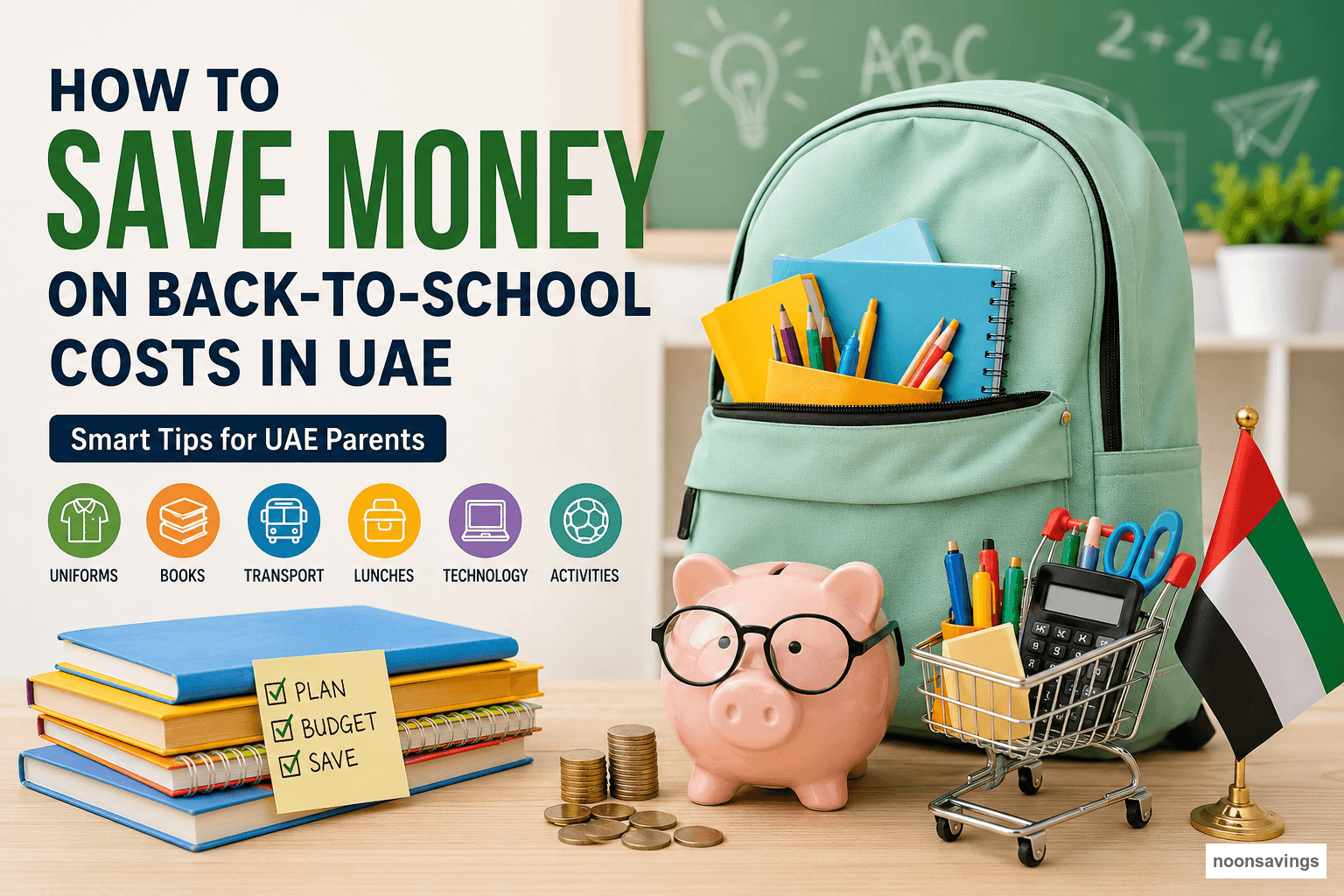
How to Save Money on Back-to-School Costs in UAE

Written byZaib Azhar✓
August 11, 202627 min read
Back-to-school season in the UAE can put surprising pressure on a family budget. Tuition may be the largest expense, but it is rarely the only one. Uniforms, books, stationery, transport, devices, lunches, activities and smaller school requirements can collectively add a significant amount to the annual cost of education.
The important point is that not every school-related expense is equally fixed.
For Dubai private schools, KHDA School Fees Fact Sheets can separate tuition and mandatory charges from required supplies and optional services. Individual fact sheets show how dramatically these additional costs can vary: uniforms may cost hundreds of dirhams, transport can run into thousands, and some schools list laptops or digital devices as another substantial expense.
That means one of the best ways to save is not simply hunting for a back-to-school sale. It is understanding which expenses you actually have to pay, which ones you can shop around for, and which optional costs you can avoid or reduce.
This guide walks through that process.
Quick takeaway: Before buying anything, get your school's complete requirements and fee breakdown. Separate mandatory expenses from optional ones, check which supplies can be purchased independently, reuse what you already own, and then shop strategically for what remains.
Why Back-to-School Costs Add Up So Quickly
The difficulty with school expenses is that they do not always arrive as one bill.
Parents may initially focus on tuition, then encounter a series of additional expenses such as:
- uniforms and PE kits
- shoes
- textbooks and workbooks
- notebooks and stationery
- backpacks
- lunch boxes and water bottles
- laptops or tablets
- school transport
- canteen spending
- extracurricular activities
- trips and events
Individually, some of these purchases may seem manageable. Together, they can materially change the real cost of sending a child to school.
Official KHDA School Fees Fact Sheet examples illustrate the difference particularly well.
For example, one Dubai school's Year 1 fact sheet lists tuition of AED 4,938, uniforms at AED 750–950, books at AED 800–900, stationery at AED 250–300, and optional transport at AED 4,200–5,100.
At another school, a Grade 2 fact sheet lists required supplies that can include uniforms, stationery and a laptop or digital device, while transport, canteen, extracurricular activities, trips and several other programmes appear separately as optional services.
These examples should not be treated as typical prices for every UAE school. They demonstrate something more useful:
The headline tuition fee does not necessarily tell you the full cost of the school year.
Think in Terms of Total School Cost
Instead of asking:
How much are the school fees?
A more useful budgeting question is:
How much will this school cost our family over the entire academic year?
That small change in thinking can reveal hundreds or even thousands of dirhams in expenses that would otherwise appear unexpectedly.
Start With Your School's Official Cost Breakdown
Before visiting a mall or filling an online shopping basket, find out exactly what your school requires.
For parents of children attending private schools in Dubai, the school's KHDA School Fees Fact Sheet is particularly useful.
Depending on the school, it can show:
- tuition
- mandatory fees
- required educational supplies
- uniform costs
- books
- stationery
- digital devices
- transport
- extracurricular activities
- canteen costs
- school trips
- other optional services
Crucially, some fact sheets also indicate when required educational supplies may be purchased from the school or from external suppliers, if available.
That is something worth checking before assuming you have to buy everything through the school.
Questions to Ask Before Paying
If something is not clear, ask the school:
- Is this item mandatory?
- Does it have to be purchased from the school?
- Can I buy the same item elsewhere?
- Can last year's uniform still be used?
- Are second-hand uniforms permitted?
- Are all books required from the first week?
- Does my child need their own laptop or tablet?
- Which activities are optional?
- Is school transport compulsory?
- Are there sibling or early-payment discounts?
Do not assume the answer.
The lesson is simple:
Verify first, spend second.
Build a Back-to-School Budget Before Shopping
Going shopping first and calculating the total afterwards is backwards.
Start with a budget.
A simple structure might look like this:
| Expense | Priority | Can You Shop Around? | Budget |
|---|---|---|---|
| Tuition and mandatory fees | Essential | Usually limited | AED ___ |
| Uniform | Essential | Depends on school | AED ___ |
| Shoes | Essential | Usually yes | AED ___ |
| Books | Essential | Depends on school | AED ___ |
| Stationery | Essential | Usually yes | AED ___ |
| Backpack | If needed | Yes | AED ___ |
| Lunch box and bottle | If needed | Yes | AED ___ |
| Laptop or tablet | Only if required | Usually yes | AED ___ |
| Transport | Depends on family | Compare options | AED ___ |
| Activities | Often optional | Yes | AED ___ |
| Canteen and lunch | Recurring | Yes | AED ___ |
| Emergency buffer | Recommended | — | AED ___ |
The most important column is not actually the price.
It is:
Can you shop around?
That tells you where your effort is most likely to produce savings.
Divide Expenses Into Three Groups
1. Fixed or Mandatory
These may include tuition and compulsory school charges.
There may be relatively little room to reduce them once you have chosen the school, although applicable sibling, corporate, employee or early-payment discounts are worth checking.
2. Required but Flexible
This is often where parents have more control.
Examples may include:
- shoes
- stationery
- backpacks
- lunch boxes
- water bottles
- some uniforms
- some books
- technology
Whether you can purchase a particular item independently depends on the school's rules.
3. Optional
These deserve the most scrutiny.
Examples can include:
- extracurricular activities
- selected school trips
- canteen spending
- camps
- clubs
- photographs
- enrichment programmes
Optional does not mean unnecessary. A child may get genuine value from an activity.
But it does mean:
You should make a deliberate decision rather than treating every item on a school document as automatically compulsory.
School Uniforms: Buy What Your Child Actually Needs
Uniform shopping is one of the easiest places to overspend because parents naturally want everything ready before the first day.
But children grow quickly.
Buying a large quantity of every uniform item before school starts can leave you with clothes that are barely used before they become too small.
A more practical approach is to start with enough items to comfortably manage your household's washing cycle, then add more if you discover they are genuinely needed.
Before Buying New Uniforms
Check what you already have.
If your child attended the same school last year, inspect:
- shirts
- trousers
- skirts
- shorts
- PE kit
- jumper or cardigan
- school bag
- shoes
Separate everything into:
- Fits and usable
- May last another term
- Needs replacing
- No longer usable
This simple exercise can prevent duplicate purchases.
Ask About Second-Hand Uniforms
Some schools or parent communities operate uniform exchanges, resale groups or informal hand-me-down networks.
This can be particularly useful for items that children outgrow before wearing them out.
A second-hand PE shirt or jumper in good condition performs exactly the same function as a new one.
Always check your school's policy before purchasing.
Do Not Automatically Buy the Largest Uniform Package
If the school or supplier offers bundles, calculate the individual cost first.
A bundle is only a saving if you actually need everything inside it.
A family that washes uniforms frequently may need fewer sets than a family that prefers doing laundry only once or twice a week.
The cheapest uniform strategy is therefore not necessarily:
Buy the cheapest uniform.
It is:
Buy the smallest practical quantity that comfortably works for your household.
Books and Stationery: Check Before Buying
Stationery shopping is where back-to-school enthusiasm can quietly become expensive.
A new backpack, matching pencil case, branded bottle, notebooks, colouring supplies, lunch accessories and character-themed stationery can quickly turn a short school list into a much larger purchase.
Start with the official list.
Then search your home.
You may already have perfectly usable:
- pencils
- rulers
- erasers
- sharpeners
- colouring pencils
- folders
- scissors
- glue
- notebooks
- geometry sets
- art supplies
There is little financial benefit in replacing usable supplies simply because a new school year is starting.
Do Not Confuse a New School Year With Everything Needing to Be New
A backpack that survived last year in good condition does not suddenly become unsuitable because a new term has started.
The same applies to:
- lunch boxes
- water bottles
- pencil cases
- calculators
- tablets
- headphones
- art supplies
This is one of the simplest principles in this guide:
Replace what needs replacing, not everything associated with school.
Part 1 Takeaway
The first stage of saving on back-to-school costs happens before you buy anything.
The sequence should be:
Check the school's requirements → separate mandatory and optional expenses → inspect what you already own → establish a budget → then start shopping.
That prevents one of the most common forms of back-to-school overspending: buying first and deciding what was actually necessary later.
Technology: Don't Automatically Upgrade
Technology can become one of the most expensive back-to-school purchases, particularly when a school requires students to use a laptop or tablet.
Before buying anything, confirm exactly what the school requires.
Ask:
- Is a personal device mandatory?
- What operating system is required?
- Are there minimum RAM or storage requirements?
- Does the device need a touchscreen or stylus?
- Is a particular brand required?
- Can an existing family laptop be used?
- Does the school provide devices during lessons?
- Are specific applications or subscriptions required?
The difference between "your child needs access to a laptop" and "your child must own this particular model" can be thousands of dirhams.
Check the Device You Already Own
A laptop does not need to be new to handle:
- Google Classroom
- Microsoft Teams
- web research
- presentations
- documents
- spreadsheets
- online homework
- educational websites
If an existing device meets the school's technical requirements and still performs reliably, replacing it purely because a new school year has started is unnecessary.
Before upgrading, consider:
- Freeing storage space.
- Removing unused software.
- Updating the operating system.
- Replacing an ageing battery if economical.
- Adding RAM or storage where the device allows it.
A relatively inexpensive repair or upgrade can sometimes extend a laptop's useful life by another year or two.
Refurbished Can Be Worth Considering
For families buying a device primarily for schoolwork, a reputable refurbished laptop can offer better value than purchasing the cheapest new model available.
But focus on reliability rather than simply finding the lowest price.
Check:
- warranty
- battery health
- device age
- screen condition
- keyboard condition
- charger availability
- software compatibility
A very cheap device that needs replacing after a few months is not a saving.
Don't Overspecify a School Laptop
A child who mainly needs Word, PowerPoint, a browser and educational applications generally does not need a premium gaming laptop.
Pay for the features the student will actually use.
That principle applies to tablets as well.
Features such as very large storage, cellular connectivity, premium accessories or top-tier processors may substantially increase the cost without materially improving the school experience.
School Transport and the Hidden Annual Cost
Transport deserves more attention than it usually gets because it is a recurring expense rather than a one-off back-to-school purchase.
School bus fees can add thousands of dirhams to the annual education budget, depending on the school, location and route.
For some families, the school bus is still the most practical solution.
The question should not simply be:
Is the bus expensive?
Instead ask:
What does each realistic transport option cost our family in money and time?
Compare the Real Alternatives
Your options may include:
- school transport
- driving yourself
- carpooling
- public transport for older students
- sharing school runs between parents
Driving may initially appear cheaper than paying for a school bus, but include:
- fuel
- Salik
- additional mileage
- parking where applicable
- vehicle maintenance
- time spent driving
- additional commuting caused by school timings
If school is significantly out of your normal route, two return trips every weekday can create a meaningful transport expense.
Calculate the Annual Cost
Instead of comparing monthly figures alone, calculate:
Monthly transport cost × number of school months
For driving, estimate:
Daily school kilometres × school days × approximate vehicle running cost
Even a rough calculation is more useful than assuming one option is cheaper.
Carpool Carefully
If another family lives nearby and children attend the same school, alternating school runs can reduce:
- fuel use
- mileage
- driving time
- daily stress
It works best when expectations are clear from the beginning.
Discuss:
- pickup times
- drop-off responsibilities
- child seats where required
- absence days
- emergency arrangements
Saving money is useful, but safety and reliability should always come first.
School Lunches: A Small Daily Cost That Becomes a Large Annual Expense
School meals are a good example of why recurring expenses matter.
AED 15 spent occasionally may feel insignificant.
AED 15 spent every school day is different.
For illustration:
AED 15 × 20 school days = AED 300 per month
Across several school months, the amount becomes substantial.
That does not mean children should never buy food from the school canteen.
It means the decision deserves a budget.
Packed Lunch vs School Canteen
For many families, packed lunches offer greater control over:
- cost
- portion size
- ingredients
- food preferences
- leftovers
But a homemade lunch is only cheaper when it is planned properly.
Buying lots of individual snack packs, premium juice boxes and pre-packaged convenience foods can make a packed lunch surprisingly expensive.
Build Lunches Around Normal Grocery Shopping
Use ingredients already being purchased for the household.
For example:
- sandwiches or wraps
- fruit
- yoghurt
- homemade snacks
- cut vegetables
- leftovers where appropriate
- refillable water bottles
Buying larger household packs and portioning food at home can often cost less than buying individually packaged school snacks.
If groceries are already taking a significant portion of your household budget, our guide to saving money on groceries in Dubai covers practical ways to reduce supermarket spending without compromising unnecessarily on food quality.
Give Older Children a Canteen Budget
If your child is old enough to manage money, set a weekly or monthly allowance rather than paying for whatever is purchased.
For example:
You have AED ___ for school canteen purchases this week.
This turns a recurring expense into a defined budget and can also help children understand financial choices.
Extracurricular Activities: Choose Value, Not Quantity
Activities can be one of the most rewarding parts of school life.
Sports, music, coding, art, languages and clubs can help children develop interests and skills beyond the classroom.
But parents can easily end up enrolling children in too many activities at once.
That creates two problems:
- higher expenses
- an overloaded weekly schedule
Start With One Activity That Matters
Instead of signing up for several programmes immediately, consider choosing one activity your child genuinely enjoys.
Evaluate it for a term.
If the child remains interested and the family schedule comfortably supports it, consider adding another activity later.
Compare School and External Options
A school activity is not automatically cheaper than an external programme, and an external programme is not automatically better.
Compare:
- total term cost
- number of sessions
- session duration
- equipment costs
- transportation
- instructor quality
- convenience
A programme costing less per session may still be more expensive overall if it requires substantial additional driving or equipment.
Watch for Equipment Costs
The advertised activity fee may only be the beginning.
For example, some activities may require:
- uniforms
- sports shoes
- instruments
- protective equipment
- competition fees
- exam fees
- travel
Ask about the complete expected cost before committing.
Where to Look for Back-to-School Savings in UAE
Once you know what you actually need, you can start shopping strategically.
The goal is not to buy everything from the cheapest shop.
Different retailers can be better for different categories.
Supermarkets and Hypermarkets
Large supermarkets can be useful for:
- notebooks
- pens
- pencils
- lunch boxes
- water bottles
- basic backpacks
- art supplies
Back-to-school periods often result in dedicated sections containing stationery and school essentials.
Compare the final price rather than relying on large discount labels.
Our comparison of the best budget supermarkets in Dubai can also help when deciding where everyday household and school-related purchases may offer better overall value.
Discount and Value Stores
Discount stores can work particularly well for simple items where branding makes little practical difference.
Examples include:
- rulers
- erasers
- folders
- craft supplies
- basic stationery
- lunch accessories
For frequently replaced items, paying significantly more purely for a character or logo rarely improves usefulness.
Online Shopping
Online marketplaces make price comparison much easier.
Before ordering:
- Compare the exact model or item.
- Include delivery fees.
- Check seller ratings.
- Review return conditions.
- Confirm delivery time before school begins.
A low advertised price is not necessarily cheaper once shipping or minimum-order requirements are added.
School Parent Groups
Parent WhatsApp and Facebook groups can be surprisingly useful.
Families may offer:
- used uniforms
- textbooks
- calculators
- school bags
- sports equipment
- educational materials
Children often outgrow school items before those items wear out.
Buying second-hand can therefore be particularly sensible for equipment with a short useful life.
When Back-to-School Sales Actually Save Money
A sale does not automatically mean you are saving money.
The easiest way to overspend during a promotion is to buy something you did not originally intend to purchase.
Use Your Shopping List as a Filter
Before looking at promotions, create your actual school list.
Then judge every offer against that list.
Ask:
Would I have bought this item without the discount?
If the answer is no, the discount has probably encouraged additional spending rather than saving money.
Compare the Final Price
A large percentage discount can still leave an item more expensive than an equivalent product elsewhere.
Compare the final price, not merely the discount percentage.
This is especially important for:
- backpacks
- electronics
- shoes
- branded stationery
- lunch accessories
Don't Stockpile Children's Items Too Aggressively
Buying supplies in bulk can work for items that will definitely be used, such as:
- pencils
- notebooks
- printer paper
- basic stationery
Be more cautious with:
- uniforms
- shoes
- backpacks
- clothing
- sports equipment
Children's sizes and preferences change.
Saving 20% on something that is never used is still a 100% waste of the money spent.
Use Cashback and Credit Cards Carefully
If you already use a cashback credit card and can pay the balance in full, school-related purchases may help you recover a small percentage of what you would have spent anyway.
But cashback should never be the reason to spend more.
For example:
Spending AED 1,000 unnecessarily to earn AED 50 cashback still leaves you AED 950 worse off.
Use rewards only on purchases already included in your budget.
If you're comparing cards for everyday household spending, our guide to the best credit cards in UAE explains how different card types suit different spending habits.
Don't Carry Debt for School Shopping
School expenses can create a large short-term cash requirement.
If paying by credit card, know exactly how the balance will be repaid.
Credit-card interest can quickly eliminate:
- cashback
- discounts
- reward points
- sale savings
A discounted school purchase stops being cheap when interest is added for several months.
Spread Purchases Across the Year
Not every school expense needs to happen before the first day of term.
Some purchases can wait until you know they are required.
For example:
- additional uniforms
- spare shoes
- extra stationery
- activity equipment
- optional accessories
Start with essentials.
After several weeks of school, you will have a much clearer understanding of what your child actually uses.
Create a Monthly School Sinking Fund
One of the best ways to make the next school year easier is to start preparing immediately after this one begins.
Suppose you expect non-tuition school expenses of approximately AED 3,600 over the year.
Instead of facing AED 3,600 at once:
AED 3,600 ÷ 12 = AED 300 per month
You could gradually set aside AED 300 each month.
The exact figure will obviously depend on your family's expenses.
The principle matters more than the amount.
Create a separate savings category for:
School Expenses
Then contribute to it throughout the year.
This turns a predictable annual expense into a manageable monthly one.
Track What You Actually Spend
Your first back-to-school budget will probably not be perfect.
That is fine.
Keep a simple record of what you actually spend.
For example:
| Category | Budget | Actual Spend |
|---|---|---|
| Uniform | AED 500 | AED 460 |
| Shoes | AED 250 | AED 290 |
| Stationery | AED 300 | AED 225 |
| Books | AED 750 | AED 750 |
| Technology | AED 0 | AED 0 |
| Activities | AED 600 | AED 750 |
| Total | AED 2,400 | AED 2,475 |
Next year, you will already have a realistic starting point.
That is far more useful than searching online for an "average UAE school budget" that may have little connection to your own child's school.
If you're trying to understand how education fits into the wider household budget, our Cost of Living in Dubai guide can help put school expenses alongside housing, groceries, transport, utilities and other major costs.
Part 2 Takeaway
Once the essential school requirements are clear, the biggest opportunities usually come from controlling recurring expenses rather than chasing the biggest one-time discount.
Technology, transport, lunches, activities and small everyday purchases can quietly add thousands of dirhams over an academic year.
The practical approach is:
Buy only the technology you need → compare the full cost of transport → put boundaries around canteen spending → choose activities deliberately → shop from a list → use promotions strategically → spread predictable costs across the year.
Part 3 will bring everything together with the most important back-to-school spending mistakes, a practical family checklist, FAQs and the final decision guidance.
Common Back-to-School Spending Mistakes
Saving money on school expenses is not only about finding cheaper products. Avoiding unnecessary purchases can have an even greater impact.
Here are some of the most common mistakes worth watching for.
Buying Everything Before the First Day
Parents understandably want their children fully prepared, but not every possible item needs to be purchased before school begins.
Start with:
- mandatory uniforms
- required books
- essential stationery
- suitable shoes
- necessary technology
- basic lunch supplies
Wait before buying large quantities of extras.
Once the first few weeks have passed, you will have a much clearer idea of what your child genuinely needs.
Assuming Everything on a School List Must Be Bought From the School
Some items may need to come from an approved supplier, particularly branded uniforms or specific educational materials.
Others may be available elsewhere.
Check the school's requirements rather than assuming.
For Dubai private schools, the KHDA School Fees Fact Sheet can also help parents distinguish tuition, mandatory charges, required educational supplies and optional services.
Buying for the Entire Year at Once
Bulk buying can save money on predictable consumables.
It makes less sense for items affected by:
- growth
- changing activities
- changing preferences
- school requirements
A child may outgrow shoes or uniforms long before you expected.
Buy ahead when the future need is reasonably certain, not simply because something is discounted.
Choosing the Cheapest Option Without Considering Durability
The lowest-priced backpack, shoes or water bottle will not necessarily have the lowest annual cost.
Suppose one school bag costs AED 60 but needs replacing twice, while a better-made AED 100 bag lasts the entire year.
The cheaper purchase becomes:
AED 60 × 2 = AED 120
Price matters, but so does expected lifespan.
This does not mean buying premium brands. It means considering value rather than price alone.
Letting Small Daily Expenses Go Untracked
AED 5 here and AED 10 there rarely feel significant.
Repeated across an academic year, they can become a meaningful expense.
Watch recurring spending on:
- canteen purchases
- snacks
- drinks
- transport
- printing
- small school events
- last-minute supplies
These are precisely the expenses that tend to disappear into the general household budget.
Using Discounts as an Excuse to Spend More
A back-to-school promotion only saves money when it reduces the cost of something you already intended to buy.
A useful rule is:
Need first. Discount second.
Do not reverse the order.
A Practical Back-to-School Savings Strategy
Instead of trying dozens of isolated money-saving tricks, use a repeatable process every school year.
Step 1: Get the Complete Requirements
Collect:
- school fee information
- uniform list
- book list
- stationery list
- technology requirements
- transport information
- activity information
Do this before shopping.
Step 2: Separate Mandatory and Optional Costs
Create three categories:
| Category | What It Means |
|---|---|
| Mandatory | Must be paid or purchased |
| Flexible | Required, but you may have choices |
| Optional | You decide whether the benefit justifies the cost |
Focus your saving efforts primarily on flexible and optional expenses.
Step 3: Shop Your Home First
Before buying replacements, check:
- uniforms
- shoes
- backpacks
- stationery
- lunch boxes
- bottles
- electronics
- sports equipment
Anything reusable immediately reduces your shopping list.
Step 4: Set a Maximum Budget
Give each category a spending limit.
For example:
| Category | Maximum Budget |
|---|---|
| Uniform | AED ___ |
| Shoes | AED ___ |
| Books | AED ___ |
| Stationery | AED ___ |
| Technology | AED ___ |
| Activities | AED ___ |
| Other | AED ___ |
Your actual numbers should come from your child's school requirements and your household circumstances rather than generic online estimates.
Step 5: Compare Before Buying
Spend comparison time where the potential saving is meaningful.
Comparing five shops to save AED 2 on an eraser is probably not worthwhile.
Comparing prices before spending AED 2,000 on a laptop certainly can be.
Prioritise comparison for:
- electronics
- uniforms
- shoes
- transport
- extracurricular activities
- large stationery orders
Step 6: Delay Non-Essential Purchases
If something is not immediately necessary, wait.
This is particularly useful for:
- extra uniforms
- accessories
- additional devices
- activity equipment
- spare bags
- premium stationery
Waiting a few weeks can reveal whether the item was actually needed.
Step 7: Track the Final Cost
Record what you spend this year.
That becomes next year's starting budget.
Over time, your family's own spending history will become more useful than any generic estimate of what UAE parents supposedly spend.
Back-to-School Savings Checklist
Use this checklist before the new school term begins.
School Requirements
- [ ] Get the complete school fee breakdown
- [ ] Check the school's uniform requirements
- [ ] Get the official book list
- [ ] Get the official stationery list
- [ ] Confirm technology requirements
- [ ] Identify mandatory and optional charges
- [ ] Ask whether supplies can be purchased externally
- [ ] Check available school discounts
Before Shopping
- [ ] Check last year's uniforms
- [ ] Check shoes
- [ ] Check backpacks
- [ ] Check lunch boxes and bottles
- [ ] Check existing stationery
- [ ] Check laptops or tablets
- [ ] Check sports equipment
- [ ] Ask about second-hand options
While Shopping
- [ ] Take the official list
- [ ] Set a budget for each category
- [ ] Compare final prices
- [ ] Avoid unnecessary bundles
- [ ] Avoid buying purely because something is discounted
- [ ] Check online and offline prices for expensive items
- [ ] Consider durability for frequently used products
- [ ] Keep receipts until requirements are confirmed
Recurring Expenses
- [ ] Calculate annual transport cost
- [ ] Set a school lunch or canteen budget
- [ ] Review extracurricular activity costs
- [ ] Include equipment costs for activities
- [ ] Track small recurring school purchases
Preparing for Next Year
- [ ] Record this year's actual spending
- [ ] Create a monthly school savings category
- [ ] Keep reusable supplies
- [ ] Store uniforms that may be useful for siblings
- [ ] Review the budget before the next academic year
How Much Should You Budget for Back-to-School Costs in UAE?
There is no single amount that every UAE family should budget.
The total depends heavily on:
- the school
- the child's age
- curriculum
- uniform requirements
- technology requirements
- transport arrangements
- extracurricular activities
- how much can be reused from the previous year
This is why a generic figure such as "AED X per child" can be misleading.
A family whose child already owns a suitable laptop, reuses a backpack and does not require school transport may have a very different budget from a family buying all of those things for the first time.
Calculate Your Own Number
A more useful calculation is:
Mandatory school costs
+ required supplies
+ transport
+ expected recurring expenses
+ chosen optional activities
− items you can reuse
= your realistic school-year budget
Then add a modest buffer for unexpected requirements.
This produces a figure based on your actual circumstances rather than somebody else's household.
Where Should You Prioritise Your Savings?
Not every expense deserves the same amount of attention.
A useful way to prioritise is by combining cost with flexibility.
| Expense | Potential Cost | Flexibility | Saving Priority |
|---|---|---|---|
| Tuition | Very high | Low | Check eligible discounts |
| Transport | High | Medium | High |
| Technology | Potentially high | Medium–high | High |
| Uniform | Medium | Depends on school | Medium–high |
| Books | Medium | Depends on school | Medium |
| Stationery | Low–medium | High | Medium |
| Lunches | Recurring | High | High |
| Activities | Medium–high | High | High |
| Accessories | Low–medium | Very high | High |
The interesting point is that the largest expense is not necessarily where you have the greatest ability to save.
Tuition may dominate the education budget, but once a school has been selected there may be limited flexibility.
Lunches, activities, transport, technology and unnecessary purchases often give families much more control.
Back-to-School Savings by Family Situation
Different households should prioritise different strategies.
If You Have More Than One Child
Look for opportunities to reuse:
- uniforms where school rules and sizing allow
- books
- calculators
- sports equipment
- bags
- devices
Also ask the school whether sibling discounts apply.
Small savings become more meaningful when the same expense would otherwise be repeated for several children.
If Your Child Is Starting School for the First Time
Your initial cost may be higher because you do not already own school-specific items.
Prioritise essentials and avoid predicting everything your child will need for the entire year.
The first term will teach you a great deal about what is genuinely useful.
If Your Child Is Returning to the Same School
Your biggest advantage is existing equipment.
Do a complete inventory before shopping.
Reusing five or six perfectly good items may save more than finding a 10% discount on an entirely new shopping basket.
If You're New to the UAE
Do not assume school expenses work exactly as they did in your previous country.
Ask the school for a complete breakdown and clarify:
- transport
- uniforms
- books
- devices
- activities
- lunch arrangements
- optional fees
As you plan your wider household finances, include education alongside rent, groceries, transport, utilities and other everyday expenses.
Frequently Asked Questions
How can I reduce back-to-school costs in UAE?
Start by obtaining the school's complete requirements before shopping. Reuse suitable items from the previous year, distinguish mandatory expenses from optional ones, compare prices for flexible purchases and avoid buying large quantities of items before you know they are needed.
Recurring costs such as transport, lunches and extracurricular activities deserve particular attention because relatively small regular expenses can become substantial over an academic year.
Do I have to buy school uniforms directly from the school?
It depends on the individual school's requirements.
Some schools use designated uniform suppliers or require specific branded items. Do not purchase alternatives until you have confirmed that they comply with the school's policy.
If second-hand uniforms or parent exchanges are permitted, they can be worth considering.
Can school books and stationery be purchased elsewhere?
This depends on the school and the specific item.
Some educational materials may be school-specific, while more general supplies may be available from external retailers. For Dubai private schools, review the relevant School Fees Fact Sheet and confirm directly with the school before purchasing alternatives.
Is it cheaper to pack school lunches?
It can be, particularly when lunches are built around normal household grocery shopping rather than individually packaged convenience foods.
The best comparison is between your actual packed-lunch cost and the school's canteen prices rather than assuming one option is always cheaper.
Is school transport cheaper than driving?
Not necessarily.
Compare the annual bus fee with the real cost of driving, including fuel, Salik where applicable, additional mileage, maintenance and the time required for school runs.
For some households, school transport may offer better overall value even when its upfront price appears higher.
Should I buy school supplies during back-to-school sales?
Yes, when the sale reduces the price of something already on your shopping list.
Do not buy unnecessary items simply because they are discounted.
Compare final prices rather than relying on the advertised percentage reduction.
Should I buy a new laptop for the new school year?
Only if your child's existing device does not meet the school's requirements or is no longer reliable enough for schoolwork.
Confirm the required specifications before purchasing. A functional existing or reputable refurbished device may be sufficient depending on the school's needs.
How can I prepare for next year's school expenses?
Track what you spend this year and use that figure to establish a monthly school sinking fund.
For example, if predictable non-tuition expenses total AED 3,600 annually, setting aside approximately AED 300 each month would spread that cost across the year.
Your own previous spending is usually a better budgeting reference than a generic UAE-wide estimate.
Disclaimer
School fees, uniform requirements, book lists, transport charges, discounts, optional activities and purchasing policies vary between schools and can change.
Always confirm current requirements, fees and policies directly with your child's school or the relevant official authority before making financial decisions or purchases.
Planning tool: Use our Savings Goal Calculator to spread next year's school costs into a monthly saving plan instead of paying everything at once.
Final Thoughts
Saving money on back-to-school costs in the UAE does not require buying the cheapest version of everything.
The biggest difference usually comes from buying deliberately.
Start with the school's actual requirements. Separate mandatory costs from flexible and optional ones. Reuse what still works. Compare expensive purchases carefully. Pay attention to recurring expenses such as transport, lunches and activities, and avoid treating every promotion as an opportunity to buy more.
Families with several children may benefit most from reuse and sibling-related savings. Families buying technology should focus on what the school actually requires rather than premium specifications. Parents facing high recurring costs may find that reviewing transport, lunches and activities creates more meaningful savings than chasing small stationery discounts.
Most importantly, keep a record of what your family actually spends.
This year's back-to-school expenses can become next year's budget, allowing you to set money aside gradually instead of facing the entire cost at once.
The goal is not to spend as little as possible on your child's education. It is to make sure the money you do spend goes towards things that are genuinely required, useful and valuable.

Written byZaib Azhar✓
Zaib Azhar is a UAE-based web developer, photographer, and savings enthusiast who has been living in the UAE for over 12 years. Passionate about smart budgeting, cashback strategies, affordable living, and digital solutions, he shares practical insights to help residents save money and make informed financial decisions. With experience in web development, online research, and content creation, Zaib combines technology, creativity, and real-life UAE market knowledge to create useful guides on budgeting, banking offers, consumer deals, and cost-of-living tips.
View all articles by Zaib Azhar →