Best Credit Cards in UAE (2026): Which Card Fits Your Spending?

Written byZaib Azhar✓
April 22, 202616 min read
Choosing a credit card in the UAE is not really about finding the card with the biggest ad campaign. It is about matching the card to the way you actually spend: groceries, fuel, dining, flights, online shopping, or simple day-to-day cashback.
That is where many people get it wrong. They apply for a travel card without travelling enough, a premium card without using the benefits, or a cashback card whose earning rules only work if they hit a monthly spending threshold. The result is very common in the UAE: high expectations, low real value, and unnecessary annual fees.
This guide is built to help you decide which credit card is genuinely a good fit for you. It is not a list of random “top cards.” It is a practical breakdown of what works for different spending profiles, what the trade-offs are, and when a card should be avoided. If you are trying to improve your wider money setup as well, start with our Dubai saving guide and then review the best UAE banks for saving money before you add another product to your wallet.
Important reality check: the best credit card in the UAE is only “best” if you pay the statement balance in full and on time. If you regularly carry balances, finance charges can wipe out months of cashback or miles very quickly. In that situation, improving your cash flow matters more than chasing rewards.
How to choose a credit card in the UAE
Before looking at card names, answer these five questions honestly:
- Do you pay in full every month? If the answer is no, focus first on avoiding debt build-up rather than maximising perks.
- Where does most of your spending go? Groceries, dining, fuel, flights, and online marketplaces often earn at very different rates.
- Will you actually use premium benefits? Lounge access, golf, concierge support, and hotel perks sound attractive, but they only matter if they match your lifestyle.
- Can you realistically meet the earning conditions? Some cards only become strong after you spend a certain amount each month.
- Is the annual fee justified? A premium card is not a bargain if your real yearly return is lower than the fee you pay to keep it.
In other words, the right card is not the one with the most features. It is the one that fits your income level, your spending mix, and your discipline with repayments.
Quick comparison of practical picks
| Card | Best for | Why it stands out | What to watch |
|---|---|---|---|
| Emirates NBD Duo | Heavy everyday spend on groceries, fuel, utilities and education | Strong category rewards when the spending pattern matches the card | The best earning rate depends on hitting the monthly spend rule |
| ADCB 365 Cashback | Balanced family spending across groceries, dining and fuel | Useful category spread for normal UAE living costs | Monthly spend requirement and cashback cap matter |
| HSBC Live+ | Dining-led lifestyle with steady monthly card usage | Useful for people who spend heavily on restaurants and fuel | Value drops if you do not reach the spend threshold |
| Mashreq noon Credit Card | Frequent noon shoppers | Free-for-life structure and strong noon ecosystem fit | Outside its partner ecosystem, the value is far less exciting |
| Emirates Islamic Amazon Credit Card | Regular Amazon.ae shoppers | Clear use case for households that already buy often on Amazon | It is a niche card, not a universal everyday winner |
| HSBC Cash+ | High-income users who want simple uncapped cashback | Simple structure with no category tracking | High salary requirement, and the fee only makes sense if you use it well |
| Emirates NBD Skywards Signature / Infinite | Frequent Emirates or flydubai travellers | Miles make more sense than generic cashback if you fly enough | Weak fit for light travellers, and fees are harder to justify |
Best cashback cards for everyday UAE spending
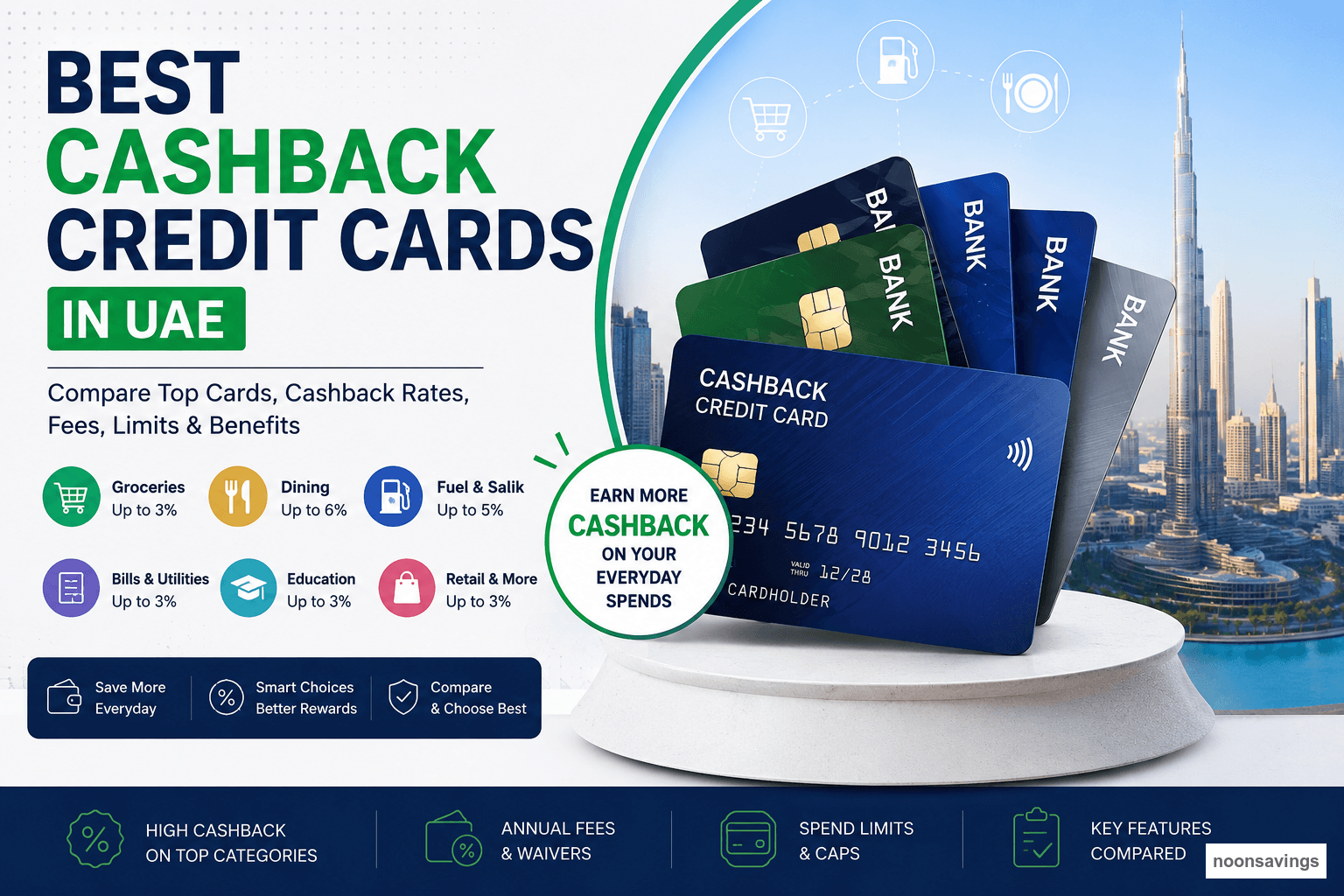
For many UAE residents, the best card is not a glamorous travel card. It is a card that quietly returns value on recurring daily costs such as groceries, school-related spending, fuel, dining, utility payments, and household essentials.
1. Emirates NBD Duo: strongest when your life matches its reward categories
Emirates NBD Duo is a practical cashback-style choice when your spending is concentrated in household categories. The bank currently lists 5% Plus Points on groceries, electronics, utilities, education and fuel, with a lower earning rate on other spending. That can be valuable for families whose budget already looks like that; it is not a reason to manufacture extra spending just to earn points.
The eligibility filter is important: Emirates NBD currently lists a minimum salary of AED 12,000 and says the card is exclusive to Abu Dhabi residents. Treat its annual-fee offer and reward conditions as live terms, not permanent assumptions.
Read the official Emirates NBD Duo page and its key facts documents before applying.
2. ADCB 365 Cashback: one of the most practical all-rounders for family spending
ADCB 365 Cashback is easy to understand for many households because its published categories map to normal UAE spending: groceries, dining, fuel, Salik and selected digital subscriptions. That makes it a credible all-rounder when these are already meaningful parts of your monthly budget.
The conditions decide whether the headline rates are useful. ADCB currently requires at least AED 5,000 of monthly purchases to unlock cashback rewards and caps total monthly cashback at AED 1,000. It also lists an annual fee from the second year, so calculate your realistic return after the fee rather than comparing percentages alone.
See the official ADCB 365 Cashback page for live categories, caps, eligibility and fees.
3. HSBC Live+: good for dining-heavy users, but only if spending is consistent
HSBC Live+ is a logical shortlist card for people who genuinely spend on dining, fuel, groceries and entertainment. HSBC currently advertises up to 6% cashback on dining, 5% on fuel and 2% on groceries and entertainment, but the higher category rates require at least AED 3,000 in monthly spend and are subject to category caps.
It is therefore a lifestyle card, not a universal answer. HSBC currently waives the annual fee after year one when annual spending reaches AED 12,000; otherwise a fee applies. Check that the salary and spending requirements are comfortable for your normal budget before using the card as a rewards strategy.
Review the official HSBC Live+ page for the live reward, eligibility and fee conditions.
Best cards for online shopping and marketplace spending
Some UAE users spend more online than offline. If that sounds like you, a marketplace-focused card can outperform a generic cashback card, but only if you actually buy often enough inside that ecosystem.
4. Mashreq noon Credit Card: best if noon is already part of your routine
If you order often from noon, noon Food or noon Minutes, the Mashreq noon Credit Card has one of the clearest use cases in this market. Mashreq currently advertises no annual fee and up to 5% cashback within the noon ecosystem, alongside a lower rate on other eligible spending.
The important limitation is that the cashback is a noon-focused benefit, not cash you can automatically treat as a general bank-credit replacement. Read the exclusions and understand how and where noon credits can be used. If noon is not already a significant part of your routine, a broad cashback card may be more useful.
Check the official Mashreq noon card page and terms for current categories and exclusions.
5. Emirates Islamic Amazon Credit Card: strong for Amazon shoppers, not for everyone else
The Emirates Islamic Amazon Credit Card is a targeted tool, not a market-wide winner. Emirates Islamic currently advertises up to 6% back on Amazon.ae spending for eligible Prime members, with lower published rates for other spend types, no annual membership fee and a higher-income eligibility tier for this version of the card.
If Amazon is a major part of your household shopping, this may be more relevant than a generic rewards ranking. If it is not, the specialised value falls quickly. Check the applicable card tier, your Amazon Prime status, merchant-category exclusions and the current welcome-offer dates before applying.
Use the official Emirates Islamic Amazon Credit Card page alongside our product-specific review for context.
Best travel cards if you actually fly enough
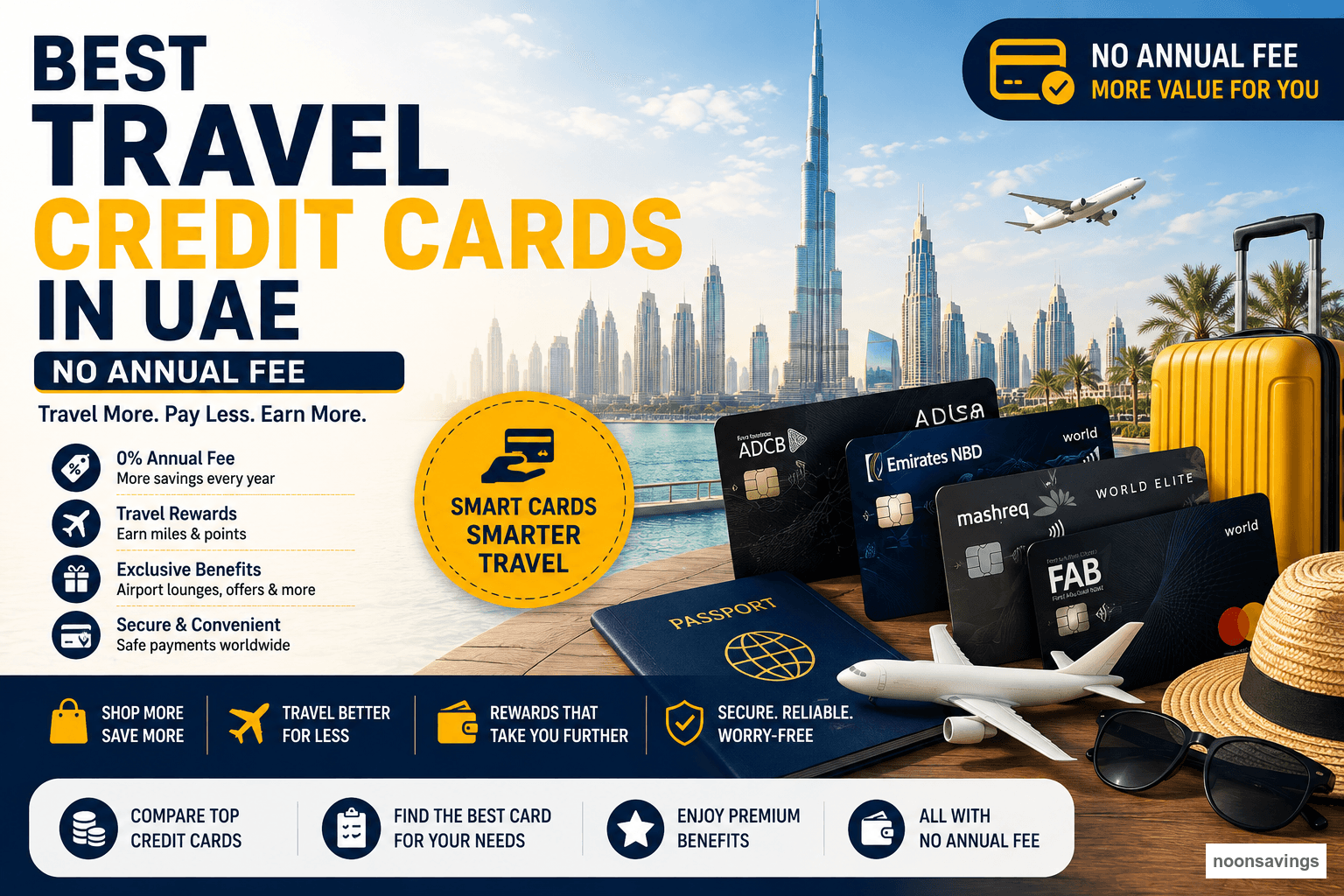
Travel cards are often the most over-applied products in the UAE. They look aspirational, but they only make financial sense when you genuinely travel often, redeem intelligently, and value the airline ecosystem enough to justify the fee structure.
6. Emirates NBD Skywards Signature: better for regular Emirates travellers than casual holiday users
The Emirates NBD Skywards Signature card makes sense when Emirates or flydubai travel is already part of your life. Emirates NBD currently lists a minimum salary of AED 12,000, a joining fee and an annual fee from the second year, plus Skywards earning and airport-lounge benefits.
That means it is not a casual-holiday card. Estimate the value you will actually get from miles, lounge access and any travel benefits after fees. If you only fly a few times a year, straightforward cashback is often easier to use and value.
See the official Skywards Signature page for live fees, eligibility and mileage rules.
7. Emirates NBD Skywards Infinite: only for genuinely high-income, high-travel users
Skywards Infinite is a premium travel product for people who already travel frequently and can use premium airline benefits. Emirates NBD currently lists a AED 30,000 minimum salary, a joining fee and an annual fee, so the decision should be based on a real travel pattern rather than the appeal of a premium label.
It can be worthwhile for a high-income Emirates or flydubai loyalist who values the published Skywards earning, lounge access and status-related benefits. For a user primarily trying to save money, the fee and opportunity cost often make a strong cashback or savings setup more rational.
Read the official Skywards Infinite page before applying.
Best low-fee and simple credit card options
There is a big group of users who do not want a complicated rewards strategy. They want something straightforward, low-friction, and easy to justify.
8. HSBC Cash+: best for simplicity, but only if the income requirement is realistic for you
HSBC Cash+ is appealing because its core structure is simple: HSBC currently advertises 1% cashback on eligible spending with no minimum spend and no earning cap. That can be easier to manage than a card with several categories and thresholds.
The trade-off is eligibility and cost. HSBC currently lists a AED 30,000 minimum monthly income and an annual-fee waiver after the first year only when annual spending reaches AED 24,000. It is a clean option for the right high-income user, but not a mass-market recommendation.
Review the official HSBC Cash+ page for the live fee, eligibility and reward conditions.
9. Mashreq noon again deserves a mention for people who hate annual fees
Even though it is ecosystem-specific, the Mashreq noon card is still one of the more practical low-fee recommendations because the “free for life” structure is easy to understand. If you want to keep annual fees low and your shopping behaviour already matches the card, it can be more sensible than paying up for a premium product you barely use.
Work out whether a card pays for itself
Before choosing a card, use your last three months of spending rather than a hoped-for future lifestyle. Group your normal purchases into groceries, dining, fuel, utilities, online marketplaces, travel and everything else. Apply the issuer's published reward rate only where the merchant category is eligible, then apply any monthly cap. This gives a realistic annual reward estimate.
Next, subtract every predictable cost: annual fee, supplementary-card fee if relevant, and any cost you would incur merely to meet a spend threshold. Do not count a welcome bonus as recurring value. Finally, ask one hard question: will you pay the full statement balance every month? If the answer is uncertain, finance charges can erase a year of cashback much faster than a card can earn it.
A simple comparison is often enough: a no-fee card that earns less can be the better outcome when its rewards match your normal spending and you do not need to chase a cap or spend condition.
Work out whether a card pays for itself
Before choosing a card, use your last three months of spending rather than a hoped-for future lifestyle. Group your normal purchases into groceries, dining, fuel, utilities, online marketplaces, travel and everything else. Apply the issuer's published reward rate only where the merchant category is eligible, then apply any monthly cap. This gives a realistic annual reward estimate.
Merchant coding matters. A purchase that feels like a grocery, travel or dining expense may be processed under a different category when you pay through a marketplace, delivery app, wallet or third-party checkout. That can reduce the reward rate or exclude the transaction altogether. Check the issuer's published merchant-category exclusions before relying on a headline percentage for a recurring bill.
Next, subtract every predictable cost: annual fee, supplementary-card fee if relevant, and any cost you would incur merely to meet a spend threshold. Do not count a welcome bonus as recurring value. Finally, ask one hard question: will you pay the full statement balance every month? If the answer is uncertain, finance charges can erase a year of cashback much faster than a card can earn it.
A simple comparison is often enough: a no-fee card that earns less can be the better outcome when its rewards match your normal spending and you do not need to chase a cap or spend condition.
Costs and traps that matter more than welcome bonuses
Many UAE credit card articles spend too much time on bonuses and too little time on the parts that actually damage people’s finances. These are the details that deserve more attention:
- Finance charges: if you revolve balances, the cost can overwhelm your rewards very quickly.
- Minimum-spend conditions: some cards only shine if you hit a monthly spending threshold.
- Category caps: a card offering a high percentage is less exciting when the monthly cashback ceiling is low.
- Foreign transaction costs: travel cards are not automatically “cheap abroad.” Always check FX and international transaction fees.
- Annual fee psychology: people often defend a card because they already pay the fee, not because the card still makes sense.
- Minimum payment traps: paying the minimum keeps the account current, but it does not make the debt cheap.
This is the part most people underestimate. A card that gives you a few hundred dirhams back each year is not helping you if repayment habits, late fees, or interest charges are silently costing much more.
Which credit card suits which type of user?
If you want the shortest possible answer, use this framework:
- You run a family household with high grocery, fuel and utility bills: start by comparing Emirates NBD Duo and ADCB 365 Cashback.
- You spend heavily on dining and want a card that reflects that: HSBC Live+ is one of the more logical starting points.
- You buy from noon constantly: Mashreq noon is worth serious attention.
- You buy from Amazon constantly: the Emirates Islamic Amazon card is more relevant than a generic “best card” ranking.
- You travel frequently with Emirates or flydubai: look at Skywards Signature or Infinite based on your income and travel volume.
- You want a simpler high-income cashback setup: HSBC Cash+ is a cleaner fit than a complicated category card.
- You do not pay in full every month: do not start with rewards. Fix repayment discipline first.
Verify the card economics before applying
Credit-card reward rates, annual-fee waivers, merchant categories, welcome bonuses and eligibility criteria can change. We review this guide against issuer pages, but it is not personal financial advice. Before applying, open the issuer's latest product page, key facts statement and tariff; then compare the expected annual reward with the annual fee, required spend, finance charges and your ability to repay the full statement balance on time.
Our honest recommendation
If your goal is saving money, the best UAE credit card is usually not the most premium one. It is the one that matches your real spending pattern and does not push you into artificial extra spend just to justify the card.
For many normal salaried households, the strongest starting point is usually a serious comparison between Emirates NBD Duo, ADCB 365 Cashback, and HSBC Live+, depending on whether your monthly profile is more household-heavy, mixed-family spending, or dining-led.
For marketplace-focused users, Mashreq noon and Emirates Islamic Amazon make more sense than broad rankings suggest, but only when those ecosystems are already a large part of your life. For frequent flyers, Skywards Signature or Skywards Infinite can work, but only when you will genuinely use miles and travel benefits enough to justify the economics.
If your finances are still in the stage where cash flow feels tight, your better move may be to improve your base banking structure first, build liquidity, and reduce waste. That is where our best bank accounts with no minimum balance guide and our savings-bank comparison can often create more real-life value than adding another credit product.
Frequently asked questions
Which credit card is best in the UAE for cashback?
There is no single best answer for everyone. Emirates NBD Duo, ADCB 365 Cashback, and HSBC Live+ are all strong in different situations. The right pick depends on whether your spending is concentrated in groceries and household bills, dining, or a more balanced monthly mix.
Which UAE credit card is best for online shopping?
If most of your spending happens on a specific platform, a niche card can outperform a general cashback card. Mashreq noon is strongest for heavy noon users, while the Emirates Islamic Amazon card is more relevant for frequent Amazon shoppers.
Are travel credit cards worth it in the UAE?
Yes, but only if you actually travel enough and understand how you will use the miles or benefits. For occasional travellers, a good cashback card is often simpler and more valuable.
Is a no-annual-fee card always better?
Not automatically. A low-fee or free-for-life card is attractive, but a paid card can still be better if your real yearly return clearly outweighs the fee. The key is whether you genuinely use the card’s strongest benefits.
What is the biggest mistake people make with credit cards in the UAE?
The biggest mistake is chasing rewards while carrying balances. Once interest and fees enter the picture, many “great” credit card strategies stop being great very quickly.

Written byZaib Azhar✓
Zaib Azhar is a UAE-based web developer, photographer, and savings enthusiast who has been living in the UAE for over 12 years. Passionate about smart budgeting, cashback strategies, affordable living, and digital solutions, he shares practical insights to help residents save money and make informed financial decisions. With experience in web development, online research, and content creation, Zaib combines technology, creativity, and real-life UAE market knowledge to create useful guides on budgeting, banking offers, consumer deals, and cost-of-living tips.
View all articles by Zaib Azhar →